
Crystal vs Gemstone Healing: Have you ever walked into a wellness shop and felt overwhelmed by the dazzling array of stones, each claiming unique healing properties? You’re not alone. With the global crystal market valued at billions of dollars and growing, more people than ever are turning to natural stones for emotional balance, spiritual growth, and personal well-being.
But here’s the question that confuses many newcomers: What’s the difference between crystal healing and gemstone healing? Are they the same thing? Can any stone be used for healing purposes?
In this comprehensive guide, we’ll break down the key differences between crystals and gemstones, explore their healing properties, and help you make informed choices for your wellness journey. Whether you’re a curious beginner or a seasoned collector, this article will clarify the terminology, compare the benefits, and provide practical tips for incorporating healing stones into your daily life.
Understanding Crystals and Gemstones: The Fundamentals
What Are Crystals?
Crystals are solid materials whose atoms are arranged in a highly organised, repeating three-dimensional pattern called a crystal lattice. This precise atomic structure gives crystals their distinctive geometric shapes, from the six-sided points of quartz to the cubic form of pyrite.
Key characteristics of crystals include:
- Formed through natural geological processes over thousands to millions of years
- Display consistent internal atomic structures
- Can form in various environments including volcanic activity, evaporation, and pressure changes
- Range from common varieties like clear quartz to rare specimens like moldavite
- Vary widely in color, transparency, and hardness
Popular crystals used in healing practices include amethyst, rose quartz, citrine, black tourmaline, and selenite. Each crystal is believed to possess unique vibrational frequencies that interact with the body’s energy field.
What Are Gemstones?
Gemstones are minerals, rocks, or organic materials that have been cut and polished for use in jewelry and decorative purposes. The term ‘gemstone’ is more about human valuation—beauty, rarity, and durability—than scientific classification.
Gemstones are typically categorized as:
- Precious gemstones: Diamond, ruby, sapphire, and emerald—traditionally valued for their exceptional rarity and beauty
- Semi-precious gemstones: All other gemstones including amethyst, turquoise, garnet, topaz, and peridot
It’s important to understand that many gemstones are actually crystals that have been valued for their aesthetic qualities. An amethyst, for example, is both a crystal (due to its atomic structure) and a gemstone (due to its beauty and use in jewelry).
The Critical Distinction: Not All Crystals Are Gemstones
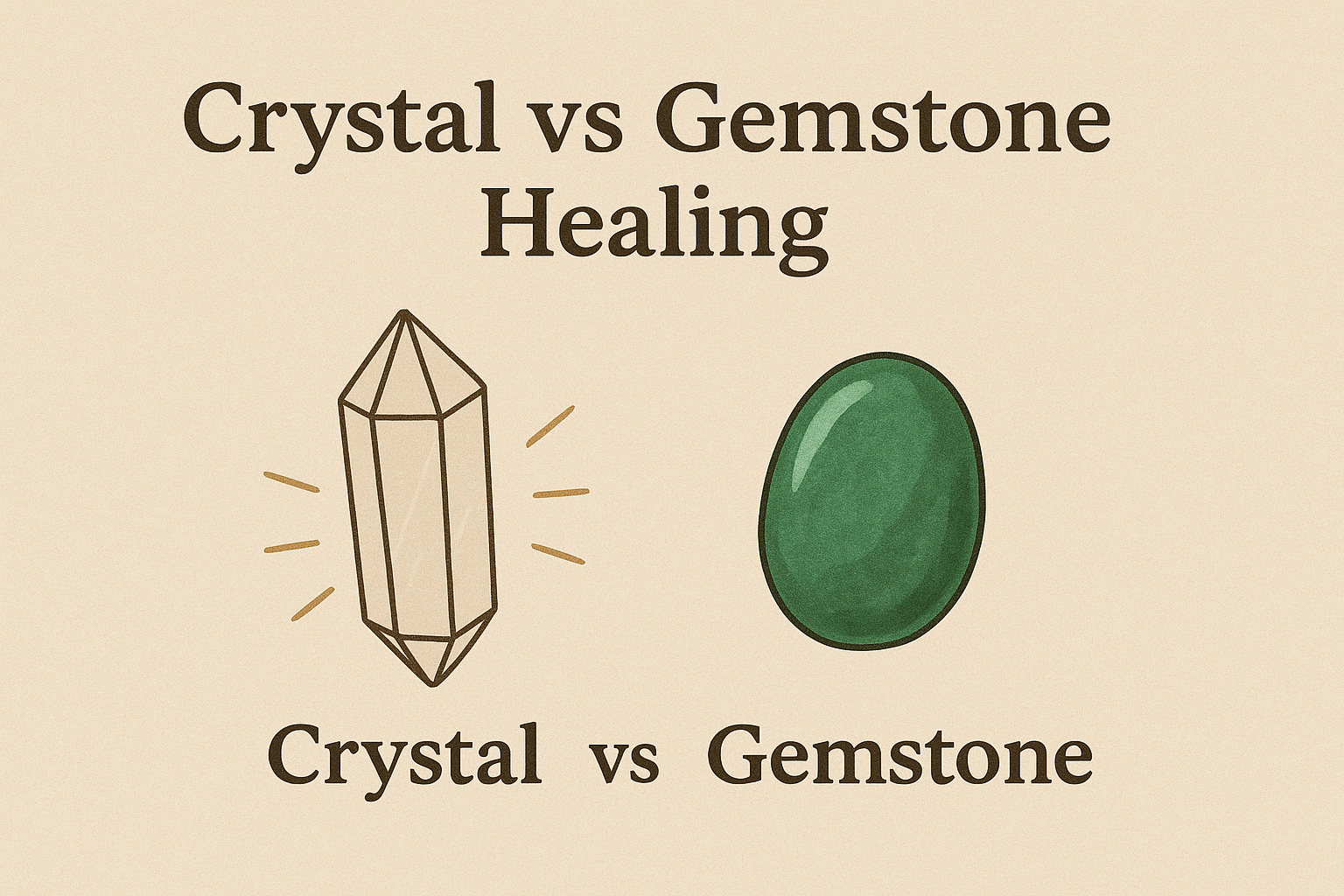
Here’s where many people get confused: all gemstones with crystalline structures are crystals, but not all crystals are gemstones. A piece of raw quartz from your backyard is a crystal, but it may not qualify as a gemstone unless it meets certain standards of beauty, clarity, and workmanship.
Similarly, some gemstones aren’t crystals at all. Pearls come from oysters (organic), amber is fossilized tree resin (organic), and obsidian is volcanic glass (amorphous, lacking crystal structure).
Crystal vs Gemstone: Side-by-Side Comparison
To help clarify the differences, here’s a comprehensive comparison table:
| Aspect | Crystals | Gemstones |
| Definition | Solids with organized atomic structure | Minerals valued for beauty and rarity |
| Classification | Scientific (based on structure) | Commercial (based on value) |
| Primary Use | Healing, meditation, energy work, decoration | Jewelry, investment, decoration, healing |
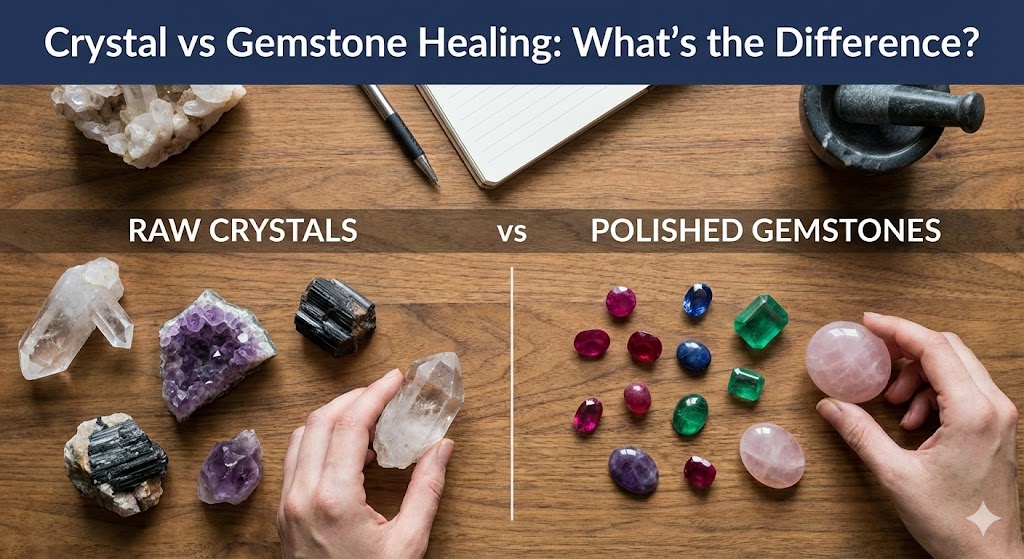
| Form | Often raw, natural points, clusters | Typically cut, polished, faceted |
| Price Range | Generally affordable to moderate | Wide range: affordable to extremely expensive |
| Healing Focus | Energy alignment, chakra work, spiritual growth | Astrological alignment, protection, prosperity |
Crystal Healing: Philosophy, Methods, and Practices
The Philosophy Behind Crystal Healing
Crystal healing is a holistic, non-invasive practice based on the belief that crystals can interact with the body’s energy field (sometimes called the aura or biofield). Practitioners believe that each crystal vibrates at a specific frequency and can influence our physical, emotional, and spiritual states.
This practice draws from various cultural traditions, including ancient Egyptian, Chinese, Greek, and Indigenous practices. While scientific research on crystal healing remains limited, many people report subjective benefits including stress reduction, improved focus, and enhanced emotional well-being.
Popular Crystals and Their Attributed Properties
Here are some of the most commonly used crystals in healing practices:
Clear Quartz (The Master Healer)
Often called the ‘master healer,’ clear quartz is believed to amplify energy and intention. It’s versatile and commonly used to:
- Enhance clarity of thought and purpose
- Amplify the properties of other crystals
- Support overall energy balance
Amethyst (Calming and Spiritual)
This purple variety of quartz is associated with:
- Stress relief and emotional balance
- Improved sleep quality
- Spiritual awareness and intuition
Rose Quartz (Love and Compassion)
Known as the ‘stone of unconditional love,’ rose quartz is believed to:
- Open the heart chakra
- Promote self-love and acceptance
- Attract harmonious relationships
Black Tourmaline (Protection)
This dark crystal is popular for:
- Protection from negative energies
- Grounding and stability
- EMF protection (electronic devices)
Common Crystal Healing Methods
Crystal healing practitioners use various techniques:
- Placement on the body: Laying crystals on specific chakra points during meditation or rest
- Carrying crystals: Keeping stones in pockets or as jewelry for continuous energy contact
- Crystal grids: Arranging multiple crystals in geometric patterns to create energy fields
- Meditation: Holding or focusing on crystals during mindfulness practices
- Environmental placement: Positioning crystals in living or working spaces
Gemstone Healing: Traditions and Modern Applications
Historical Roots of Gemstone Healing
Gemstone healing has ancient roots spanning multiple civilizations. The Egyptians used lapis lazuli and turquoise in burial rituals. Ancient Greeks believed amethyst prevented intoxication. In Vedic traditions (Jyotish), specific gemstones are prescribed based on astrological charts to balance planetary influences.
Unlike the broader term ‘crystal healing,’ gemstone healing often specifically refers to using precious and semi-precious stones that have been traditionally valued across cultures for their beauty and believed metaphysical properties.
Precious Gemstones in Healing Practices
Ruby (Vitality and Passion)
This red corundum variety is associated with:
- Energy and vitality
- Passion and motivation
- Heart health and circulation (in traditional beliefs)
Sapphire (Wisdom and Clarity)
Blue sapphire is traditionally linked to:
- Mental clarity and focus
- Truth and wisdom
- Spiritual insight
Emerald (Growth and Renewal)
This green beryl variety is believed to support:
- Emotional healing and balance
- Fertility and growth
- Heart chakra activation
Vedic Astrology and Gemstone Prescription
In Jyotish (Vedic astrology), gemstones are prescribed based on an individual’s birth chart. Each planet is associated with a specific gemstone:
| Planet | Primary Gemstone | Attributed Benefits |
| Sun | Ruby | Leadership, confidence |
| Moon | Pearl | Emotional balance, peace |
| Mars | Red Coral | Courage, vitality |
| Mercury | Emerald | Intelligence, communication |
| Jupiter | Yellow Sapphire | Wisdom, prosperity |
| Venus | Diamond | Love, luxury, creativity |
| Saturn | Blue Sapphire | Discipline, protection |
How to Choose Between Crystals and Gemstones for Healing
Consider Your Intentions and Goals
Your choice between crystals and gemstones should align with your specific wellness goals:
Choose raw crystals if you:
- Prefer natural, unprocessed specimens
- Are building a meditation or energy healing practice
- Want affordable options for creating crystal grids
- Seek larger specimens for room energy or decoration
Choose polished gemstones if you:
- Want wearable healing jewelry
- Follow astrological gemstone recommendations
- Prefer refined, aesthetically polished pieces
- Value durability for everyday wear
Budget Considerations
Budget often plays a significant role in your decision. Raw crystals like clear quartz, amethyst, and rose quartz are generally affordable, making them accessible entry points for beginners. Precious gemstones like rubies, sapphires, and emeralds can be significant investments, though semi-precious alternatives often provide similar attributed benefits at lower price points.
Trust Your Intuition
Many practitioners emphasize that the ‘right’ stone often chooses you. When shopping for healing stones, pay attention to which specimens catch your eye or feel particularly meaningful. This intuitive connection is considered important in crystal healing traditions and can guide you toward stones that resonate with your current needs.
Caring for Your Healing Stones
Cleansing Methods
Many practitioners believe that crystals and gemstones absorb energy and should be periodically cleansed. Common methods include:
- Moonlight: Placing stones under full moonlight overnight
- Sound: Using singing bowls, bells, or tuning forks
- Smoke: Passing stones through sage or palo santo smoke
- Earth: Burying stones in soil for 24 hours
- Selenite: Placing stones on a selenite charging plate
Important: Some stones are water-soluble or may fade in sunlight. Research specific care requirements for each stone type.
Storage Tips
- Store softer stones separately to prevent scratching
- Keep light-sensitive stones away from direct sunlight
- Use soft cloth pouches or padded boxes for gemstone jewelry
- Label collections if you have many similar-looking specimens
A Balanced Perspective: Science and Crystal Healing
It’s important to note that crystal and gemstone healing falls outside conventional scientific understanding. While crystals do have measurable physical properties (piezoelectricity in quartz, for example), scientific research has not validated claims about their healing effects on the human body or energy field.
That said, many users report subjective benefits from working with healing stones. These experiences may be attributed to:
- Placebo effect: Believing in the stone’s power may create real psychological benefits
- Mindfulness: Using crystals often involves meditation and intentional focus
- Ritual and routine: Incorporating meaningful objects into self-care practices
- Aesthetic enjoyment: The simple pleasure of beautiful natural objects
Crystal and gemstone healing should complement, not replace, professional healthcare. If you’re experiencing physical or mental health concerns, please consult qualified healthcare providers.
Conclusion: Finding Your Path with Healing Stones
The distinction between crystal healing and gemstone healing is primarily one of terminology and tradition rather than fundamental practice. Crystals are defined by their atomic structure, while gemstones are valued for their beauty and rarity. Many stones—like amethyst, emerald, and sapphire—fit both categories.
Whether you’re drawn to raw crystal points for meditation, polished tumbled stones for daily carry, or precious gemstones following astrological traditions, the most important factor is your personal connection to the stones you choose.
Key takeaways:
- All crystalline gemstones are crystals, but not all crystals are gemstones
- Crystal healing focuses on energy work and chakra alignment
- Gemstone healing often incorporates astrological traditions
- Your intention and connection matter more than price or rarity
- Use healing stones as a complement to, not replacement for, professional healthcare
Ready to begin your journey with healing stones? Start with one or two crystals that resonate with you, learn their attributed properties, and experiment with different methods to discover what works best for your wellness practice.
Frequently Asked Questions (FAQs)
Can I use crystals and gemstones together in healing practices?
Absolutely. Many practitioners combine raw crystals with polished gemstones in their healing work. For example, you might wear a gemstone pendant for daily energy support while using larger crystal specimens during meditation sessions. The key is to choose stones whose attributed properties complement each other and align with your intentions.
How long does it take to feel the effects of healing stones?
Experiences vary widely from person to person. Some individuals report immediate sensations like warmth, tingling, or emotional shifts when first holding certain stones. Others notice subtle changes over days or weeks of consistent use. Patience and consistent practice are often recommended, as is keeping a journal to track any changes you notice.
Are synthetic or lab-created gemstones effective for healing?
This is debated within the crystal healing community. Some practitioners believe that only naturally formed stones carry healing energy, as they’ve absorbed Earth’s vibrations over millions of years. Others argue that lab-created stones have identical physical structures and may carry similar properties. If authenticity concerns you, purchase from reputable sellers who clearly disclose the origin of their stones.
Is it safe to place crystals directly on the skin?
Most common crystals are safe for skin contact. However, some stones contain minerals that shouldn’t be placed directly on skin or immersed in water. Malachite (contains copper), cinnabar (contains mercury), and realgar (contains arsenic) are examples of stones requiring careful handling. When in doubt, research the specific composition of any stone before direct skin contact.
How do I know if my crystal or gemstone is genuine?
Authentic crystals typically have natural imperfections, inclusions, and temperature variations. Glass imitations often feel warmer and more uniform. For expensive gemstones, consider professional certification from gemological laboratories. Purchase from reputable dealers, and be skeptical of prices that seem too good to be true. Online research about the specific characteristics of each stone type can help you identify authentic specimens.
Can children safely use crystals and gemstones for healing purposes?
Crystals can be introduced to children with appropriate supervision. Choose smooth, tumbled stones without sharp edges, and select larger pieces that don’t pose choking hazards for younger children. Avoid stones with toxic mineral content. Many parents find that crystals can support calming bedtime routines or provide comfort objects. Always supervise children during any crystal-related activities and store collections safely out of reach when not in use.