
Shopping for a diamond can feel overwhelming. With countless options, confusing terminology, and significant price variations, how do you know you’re making the right choice? The answer lies in understanding the 4C’s of diamond—the universal grading system that determines a diamond’s quality, beauty, and value.
Whether you’re buying an engagement ring, anniversary gift, or treating yourself to fine jewelry, knowing how Cut, Clarity, Color, and Carat work together will save you money and ensure you get the most brilliant stone for your budget.
In this comprehensive guide, you’ll learn exactly what each “C” means, how gemologists grade diamonds, which factors matter most for visual impact, and insider tips for getting the best value. By the end, you’ll shop with confidence—knowing precisely what to look for and what questions to ask.
What Are the 4C’s of Diamond?

The 4C’s of diamond grading were established by the Gemological Institute of America (GIA) in the 1950s to create a standardized way to evaluate diamond quality. Before this system, diamond descriptions were inconsistent, making it difficult for buyers to compare stones accurately.
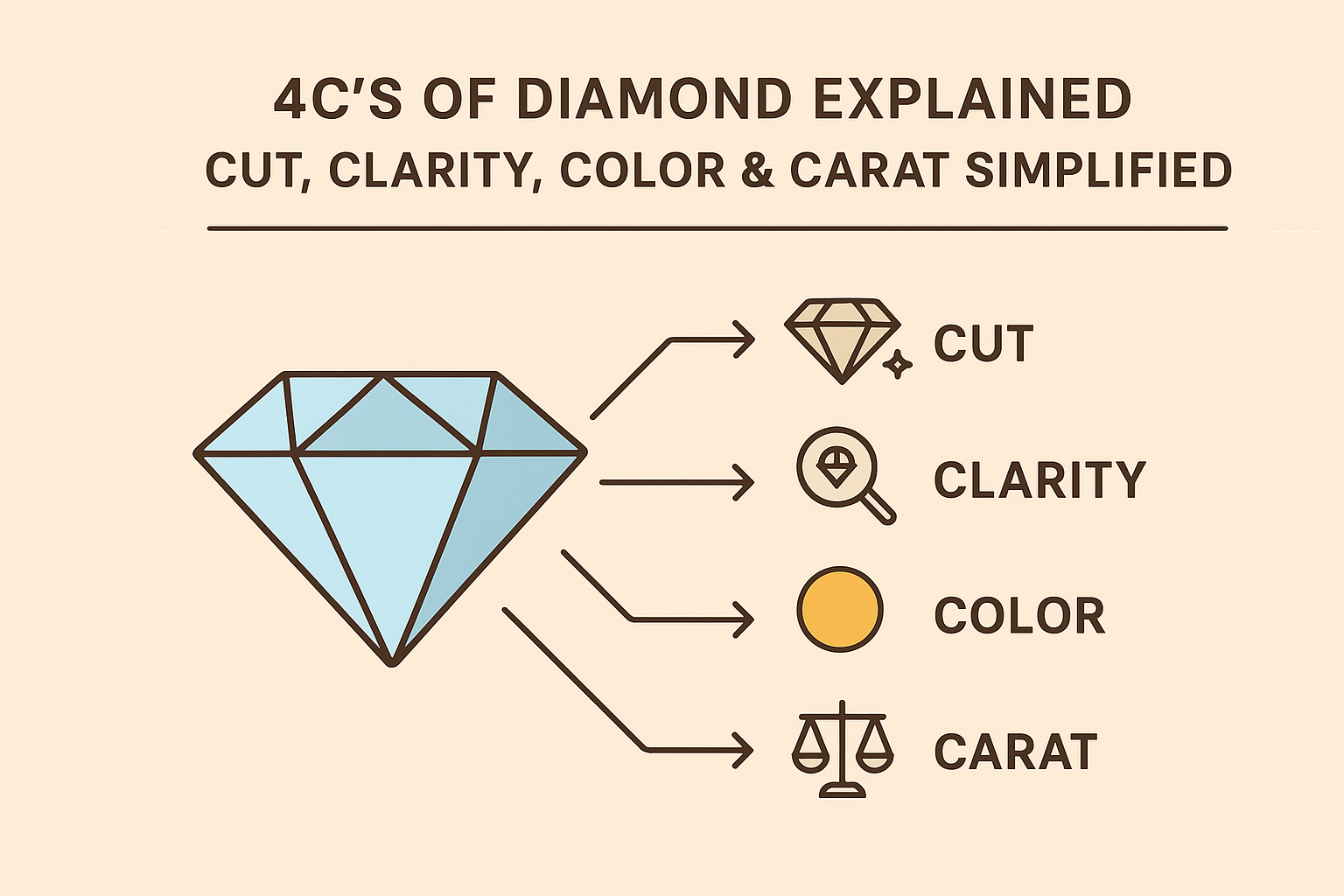
Today, the 4C’s serve as the global language for diamond quality assessment:
- Cut – How well the diamond is shaped and faceted
- Clarity – The presence of internal inclusions or external blemishes
- Color – How colorless or tinted the diamond appears
- Carat – The diamond’s weight measurement
Each factor contributes differently to a diamond’s appearance and price. Understanding their interplay helps you prioritize what matters most for your specific purchase.
Diamond Cut: The Most Important “C” for Brilliance
If you remember only one thing from this guide, let it be this: cut is the most critical factor affecting a diamond’s beauty. A perfectly cut diamond captures light, creating that mesmerizing sparkle that makes diamonds so desirable.
What Does Diamond Cut Mean?
Diamond cut refers to how precisely a diamond’s facets interact with light. It’s not about shape (round, princess, oval)—it’s about the quality of craftsmanship. A well-cut diamond reflects light internally from one facet to another, then disperses it through the top of the stone.
Three optical effects determine cut quality:
- Brilliance – The total white light reflected from the diamond
- Fire – The dispersion of light into spectral colors
- Scintillation – The pattern of light and dark areas when the diamond moves
Diamond Cut Grades Explained
The GIA grades round brilliant diamonds on a five-tier scale:
| Cut Grade | Light Performance | Recommendation |
| Excellent | Maximum brilliance and fire | Best choice for engagement rings |
| Very Good | Exceptional light return | Excellent value option |
| Good | Good light reflection | Budget-friendly without sacrificing beauty |
| Fair | Noticeable light leakage | Not recommended for center stones |
| Poor | Significant light loss | Avoid for jewelry purposes |
Expert Tip: Why Cut Trumps Carat
A smaller diamond with an excellent cut will often appear more impressive than a larger diamond with a poor cut. Poorly cut diamonds look dull and lifeless, regardless of their size or clarity. When budgeting, prioritize cut quality over carat weight.
Diamond Clarity: Understanding Inclusions and Blemishes
Diamond clarity measures the presence of internal characteristics (inclusions) and external characteristics (blemishes). Since diamonds form under extreme heat and pressure deep within the Earth, most contain natural “birthmarks” that make each stone unique.
The Diamond Clarity Scale
The GIA clarity scale contains 11 grades, ranging from Flawless to Included:
| Grade | Meaning | Visibility |
| FL | Flawless | No inclusions or blemishes at 10x |
| IF | Internally Flawless | No inclusions at 10x magnification |
| VVS1-VVS2 | Very Very Slightly Included | Difficult for expert to see at 10x |
| VS1-VS2 | Very Slightly Included | Minor inclusions at 10x magnification |
| SI1-SI2 | Slightly Included | Noticeable at 10x; may be eye-clean |
| I1-I2-I3 | Included | Obvious inclusions visible to naked eye |
What is “Eye-Clean” and Why Does It Matter?
An “eye-clean” diamond has no inclusions visible to the naked eye when viewed from approximately 6-12 inches away. This is the sweet spot for value-conscious buyers. Diamonds graded VS2 or SI1 often appear flawless to the unaided eye while costing significantly less than higher clarity grades.
Types of Diamond Inclusions
Common inclusion types include:
- Crystals – Mineral deposits within the diamond
- Clouds – Groups of tiny pinpoints
- Feathers – Small internal cracks
- Needles – Long, thin crystal inclusions
- Twinning Wisps – Intergrown crystals
Diamond Color: The Art of Colorlessness
When gemologists talk about diamond color, they’re actually measuring the absence of color. The most valuable white diamonds are completely colorless, allowing maximum light to pass through and create spectacular brilliance.
The Diamond Color Grading Scale
The GIA color scale begins at D (colorless) and progresses to Z (light yellow or brown). The scale starts at “D” to distinguish it from older, inconsistent grading systems that used A, B, and C.
| Grade Range | Category | Description |
| D-E-F | Colorless | Rare and most valuable; no visible tint |
| G-H-I-J | Near Colorless | Slight warmth; excellent value |
| K-L-M | Faint Yellow | Noticeable warmth; budget-friendly |
| N-R | Very Light | Visible yellow or brown tint |
| S-Z | Light | Obvious color; not typically used in fine jewelry |
How Metal Choice Affects Color Perception
Your ring setting metal significantly impacts how diamond color appears:
- White gold or platinum – Best for D-G color grades; reveals any warmth in lower grades
- Yellow gold – Complements H-J grades; masks slight yellow tints
- Rose gold – Pairs well with J-K grades; warm tones blend naturally
This means you can save money by choosing a slightly lower color grade when pairing with yellow or rose gold—the warmth becomes virtually undetectable.
Fancy Colored Diamonds: A Different Category
Fancy colored diamonds—yellow, pink, blue, green, and other vibrant hues—follow a completely different grading system. For these stones, more color means more value. Rare colors like natural blue or pink command premium prices.
Diamond Carat: Understanding Weight vs. Size
Carat is perhaps the most misunderstood of the 4C’s. Carat measures weight, not size. One carat equals 200 milligrams, or 0.2 grams. The term comes from carob seeds, which ancient gem traders used as counterweights because of their remarkably consistent weight.
How Carat Affects Diamond Appearance
While carat measures weight, it does correlate with size—but not linearly. A 2-carat diamond doesn’t look twice as large as a 1-carat diamond. The visual difference depends on how the diamond is cut and its shape.
| Carat Weight | Round Diameter | Popular For |
| 0.50 ct | ~5.2 mm | Delicate engagement rings |
| 0.75 ct | ~5.9 mm | Budget-conscious buyers |
| 1.00 ct | ~6.5 mm | Most popular size |
| 1.50 ct | ~7.4 mm | Statement pieces |
| 2.00 ct | ~8.2 mm | Luxury purchases |
The “Magic Sizes” and Price Jumps
Diamond prices jump significantly at certain “magic” carat weights: 0.50, 0.75, 1.00, 1.50, and 2.00 carats. A diamond weighing 0.99 carats often costs substantially less than a 1.00-carat stone, despite being visually indistinguishable.
Smart shopping tip: Consider diamonds just below these thresholds (like 0.90-0.99 carats) to maximize your budget without sacrificing appearance.
Total Carat Weight vs. Center Stone
When shopping for rings with side stones or halos, pay attention to whether the listed carat weight refers to the center stone alone or the “total carat weight” (TCW) of all diamonds. A “2 carat” ring might have a 1.5-carat center stone with 0.5 carats of accent stones.
How the 4C’s Work Together: Finding Your Perfect Balance
Understanding each individual “C” is essential, but the real skill lies in balancing all four to match your priorities and budget. Here’s how to approach the decision:
Prioritizing the 4C’s for Maximum Value
Based on visual impact and value, here’s the recommended priority order:
- Cut (Highest Priority) – Never compromise; it determines sparkle
- Carat – Choose based on personal size preference
- Color – G-H offers excellent value for white metal settings
- Clarity – VS2-SI1 provides eye-clean appearance at lower cost
Budget Allocation Strategy
For most buyers, we recommend this approach:
- Insist on Excellent or Very Good cut grades
- Choose G-I color for white gold/platinum; J-K for yellow/rose gold
- Select VS2-SI1 clarity if the diamond is eye-clean
- Consider carat weights just below “magic” numbers
- Allocate remaining budget toward carat size
Expert Tips for Buying Diamonds Using the 4C’s
Armed with your knowledge of the 4C’s, here are professional tips to ensure a smart purchase:
Always Request a Grading Report
A diamond certification from GIA, AGS, or another reputable laboratory provides an unbiased assessment of your diamond’s 4C’s. This document serves as proof of quality and is essential for insurance and resale purposes.
View Diamonds in Person When Possible
Photographs and videos can’t fully capture a diamond’s brilliance. If buying online, choose retailers offering 360-degree video, high-resolution imagery, and generous return policies.
Compare Multiple Stones
Don’t settle for the first diamond you see. Comparing several stones with similar specifications helps you recognize quality differences and ensures you’re getting the best value.
Consider the Setting’s Impact
Certain settings hide inclusions or color better than others. A bezel setting conceals edge inclusions, while prong settings expose more of the diamond. Discuss options with your jeweler.
The 4C’s in Lab-Grown vs. Natural Diamonds
Lab-grown diamonds are graded using the same 4C’s system as natural diamonds because they’re chemically, physically, and optically identical. The key differences:
- Price: Lab-grown diamonds typically cost 50-70% less than comparable natural diamonds
- Quality: Both undergo identical grading processes
- Resale: Natural diamonds historically retain value better
- Ethics: Lab-grown diamonds avoid mining concerns
Conclusion: Master the 4C’s and Shop with Confidence
Understanding the 4C’s of diamond—Cut, Clarity, Color, and Carat—transforms you from a confused shopper into an informed buyer. You now know that cut determines sparkle, clarity affects purity, color measures tint, and carat indicates weight.
More importantly, you understand how these factors interact and where to prioritize your budget for maximum impact. Whether you’re shopping for an engagement ring, anniversary gift, or personal treasure, the 4C’s give you the vocabulary and framework to evaluate any diamond confidently.
Ready to start your diamond journey? Use this guide as your reference, ask jewelers about specific grades, request certification, and compare multiple stones. The perfect diamond for your budget and preferences is waiting—now you have the knowledge to find it.
Frequently Asked Questions About Diamond Quality
Which of the 4C’s has the biggest impact on diamond price?
Carat weight has the most significant impact on price because larger diamonds are exponentially rarer. However, a smaller diamond with superior cut, clarity, and color can cost more than a larger stone with lower grades. Price increases dramatically at “magic” carat weights like 1.00, 1.50, and 2.00 carats.
Can I tell the difference between a VVS and VS diamond without magnification?
No, distinguishing between VVS (Very Very Slightly Included) and VS (Very Slightly Included) diamonds is nearly impossible without 10x magnification. Both clarity grades appear flawless to the naked eye, which is why VS diamonds offer excellent value—you get visual perfection at a lower price point.
Do all diamond shapes use the same 4C’s grading system?
Yes, all diamond shapes are evaluated using Cut, Clarity, Color, and Carat. However, the GIA only provides formal cut grades for round brilliant diamonds. Fancy shapes (oval, princess, cushion, etc.) receive polish and symmetry grades, but overall cut quality must be assessed differently—often by examining depth percentages and table sizes.
Is it possible for two diamonds with identical 4C’s grades to look different?
Absolutely. Two diamonds with the same 4C’s grades can look noticeably different because grades represent ranges, not exact measurements. Additionally, factors like fluorescence, inclusion placement, and cut proportions within the grade range affect appearance. This is why viewing diamonds in person or through high-quality video is essential.
Should I prioritize diamond certification over the 4C’s grades themselves?
Both matter, but certification from a reputable laboratory (GIA, AGS, IGI) ensures the 4C’s grades are accurate and consistent. Without certification, you’re relying on the seller’s claims. A certified diamond with slightly lower grades is often a better purchase than an uncertified diamond advertised with higher grades, because you have verified quality.
Disclaimer: This article is for educational purposes only. Diamond prices and availability vary by retailer and market conditions. Always work with reputable jewelers and request certified grading reports for significant purchases.