
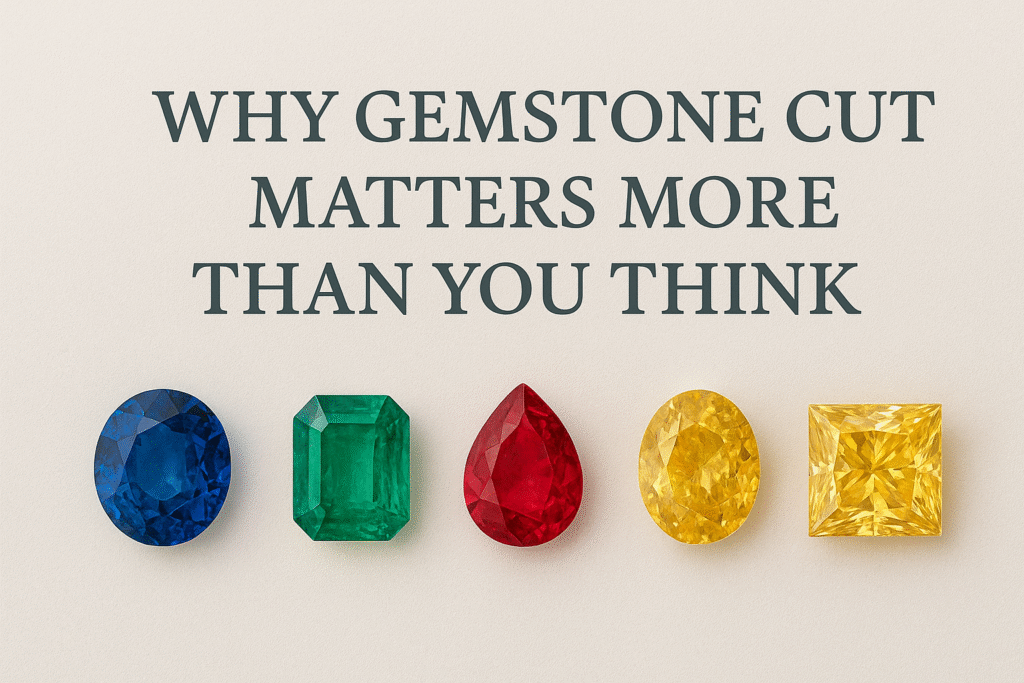
You’re standing at a jewelry counter, mesmerized by two seemingly identical gemstones. Same carat weight. Same color grade. Same clarity rating. Yet one sparkles with breathtaking fire while the other looks lifeless and dull. What’s the difference? The answer lies in a factor that most gemstone buyers criminally overlook: the cut.
Here’s the truth that jewelers don’t always emphasize: a gemstone’s cut is the single most important factor determining its visual beauty. While most shoppers obsess over carat weight or chase the highest color grade, they’re missing what actually makes a gemstone stunning.
In this comprehensive guide, you’ll discover exactly why gemstone cut matters more than you think, how it affects a stone’s brilliance and value, and how to evaluate cut quality like a professional gemologist. By the end, you’ll never look at gemstones the same way again.
What Is Gemstone Cut and Why Does It Matter?
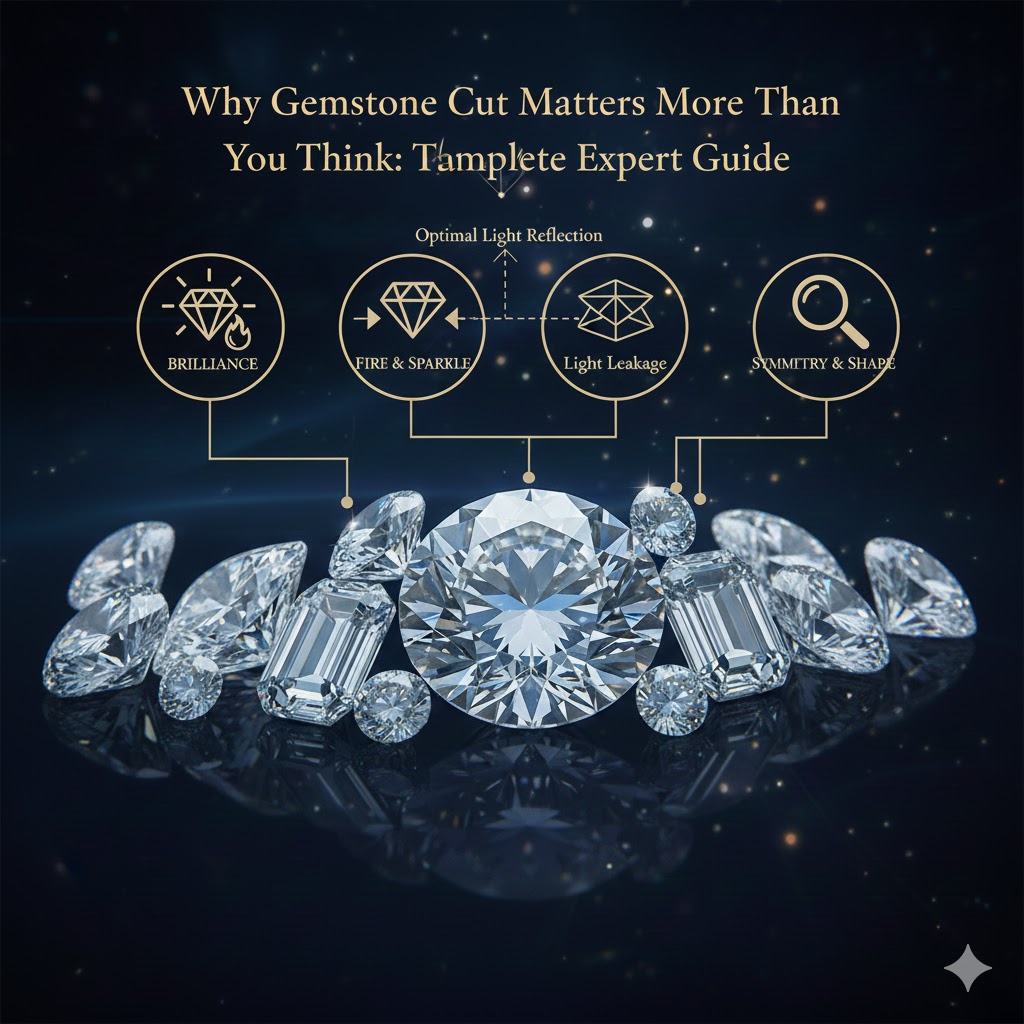
The gemstone cut refers to how a rough stone is shaped, faceted, and polished to maximize its interaction with light. Unlike the other quality factors (color, clarity, and carat weight), which are determined by nature, the cut is entirely in human hands. It’s where craftsmanship meets science, and where a skilled cutter can transform an ordinary crystal into an extraordinary jewel.
Understanding Cut vs. Shape: A Critical Distinction
Before diving deeper, let’s clear up a common misconception. Many people use “cut” and “shape” interchangeably, but they’re distinctly different concepts:
- Shape describes the gemstone’s outline when viewed from above: round, oval, pear, marquise, cushion, emerald, princess, and so on.
- Cut refers to the quality of the faceting work: the precision of angles, the symmetry of facets, and the quality of the polish. A round gemstone can have an excellent cut or a poor cut.
Think of it this way: shape is what you see at first glance, but cut is what you experience when the gem starts to sparkle.
The Science Behind Gemstone Brilliance
A well-cut gemstone acts as a precision light-management system. When light enters a properly cut stone, it bounces between internal facets at carefully calculated angles before exiting through the crown (top) and reaching your eye. This interaction creates three distinct optical phenomena:
- Brilliance: The total amount of white light reflected back to the viewer, creating that signature “glow” of a quality gemstone.
- Fire (Dispersion): The splitting of white light into spectral colors, producing those rainbow flashes that dance across the surface.
- Scintillation: The pattern of light and dark areas that shift as the gemstone moves, creating that lively “sparkle” effect.
A poorly cut gemstone leaks light through the bottom or sides, resulting in reduced brilliance and a “dead” appearance, regardless of how pure or large the stone might be.
How Cut Quality Impacts Gemstone Value
The relationship between cut quality and gemstone value is profound, yet surprisingly underappreciated by most buyers. Understanding this connection can save you thousands of dollars while helping you acquire more beautiful stones.
The Value Multiplier Effect
An excellent cut can increase a gemstone’s perceived value by 30-50% compared to a poorly cut stone of identical carat weight, color, and clarity. This isn’t just about aesthetics; it’s about how light performance affects desirability in the market.
- Premium cuts command higher prices: Stones with ideal proportions and excellent symmetry consistently sell for premium prices at auction and in retail settings.
- Poor cuts are discounted significantly: Even high-carat stones with suboptimal cuts struggle to attract buyers willing to pay market rates.
- Cut quality affects resale: Well-cut gemstones maintain their value better and are easier to sell in the secondary market.
Why Cutters Sometimes Sacrifice Quality
Here’s an insider secret: many gemstones are intentionally cut to maximize weight rather than beauty. Why? Because gemstones are typically priced per carat, and cutters face economic pressure to preserve as much material as possible from the rough stone.
A cutter might be able to produce either a stunning 2-carat gem with ideal proportions or a mediocre 2.5-carat stone with compromised angles. The math often favors the larger, less beautiful option, especially for commercial-grade production.
This is precisely why educated buyers who understand cut quality gain a significant advantage in the market.
The Key Factors That Determine Cut Quality
Evaluating gemstone cut quality requires understanding several interconnected factors. Professional gemologists assess these elements both individually and holistically to determine overall cut grade.
Proportions: The Foundation of Light Performance
Proportions refer to the relationships between different parts of a gemstone: table size, crown height, pavilion depth, and girdle thickness. These measurements, expressed as percentages of the stone’s diameter, determine how light travels through the gem.
- Table percentage: The width of the top flat facet relative to the stone’s width. Optimal range varies by shape but typically falls between 53-58% for round brilliants.
- Crown angle: The angle between the crown facets and the girdle plane. Affects the balance between brilliance and fire.
- Pavilion depth: The distance from the girdle to the culet. Too shallow causes light leakage; too deep creates a dark center.
- Girdle thickness: Should be consistent around the stone. Extremely thin girdles chip easily; overly thick girdles add hidden weight.
Symmetry: Precision in Every Facet
Symmetry measures how precisely the facets align with each other. Poor symmetry causes light to bounce in unintended directions, reducing brilliance and creating visual inconsistencies.
Key symmetry factors include facet alignment (do opposite facets match in size and position?), centering of the table and culet, and consistency of facet shapes around the stone.
Polish: The Final Touch
Polish quality refers to the smoothness of each facet’s surface. Even microscopic scratches, burn marks, or polishing lines can interfere with light entry and exit, diminishing the stone’s overall appearance.
Under magnification, an excellently polished gemstone shows mirror-like facets, while poor polish reveals surface imperfections that scatter light chaotically.
Gemstone Cut Grade Comparison Table
The following table summarizes how different cut grades affect a gemstone’s appearance and value:
| Cut Grade | Light Performance | Visual Appearance | Price Premium |
| Excellent/Ideal | Maximum brilliance, fire, and scintillation | Exceptional sparkle | +30-50% |
| Very Good | Excellent light return with minor deviations | Beautiful, lively | +15-25% |
| Good | Good light return, some light leakage | Attractive, acceptable | Market average |
| Fair | Noticeable light loss, reduced brilliance | Dull appearance | -15-30% |
| Poor | Significant light leakage | Lifeless, dark areas | -40-60% |
Popular Gemstone Cuts Explained
Different cut styles have evolved over centuries, each designed to maximize the beauty of specific gemstone types or to create particular visual effects. Understanding these cuts helps you choose the best option for your preferences and the stone you’re considering.
Round Brilliant Cut
The round brilliant remains the most popular and scientifically optimized cut, featuring 57 or 58 facets arranged to maximize light return. Developed through mathematical modeling, this cut represents the pinnacle of light performance for most transparent gemstones.
- Best for: Diamonds, white sapphires, moissanite, and any stone where brilliance is paramount
- Light performance: Exceptional brilliance and fire when well-cut
- Consideration: Higher per-carat price due to significant rough material loss during cutting
Princess Cut
The princess cut combines the fire of a round brilliant with a contemporary square or rectangular outline. Its angular facets create a distinctive sparkle pattern that appeals to modern aesthetics.
- Best for: Diamonds, cubic zirconia, and stones where a geometric look is desired
- Light performance: Excellent brilliance with distinctive crushed ice sparkle
- Consideration: Pointed corners require protective settings to prevent chipping
Oval Cut
The oval cut offers the brilliance of a round cut in an elongated shape that creates the illusion of greater size and flatters the finger with its lengthening effect.
- Best for: Diamonds, sapphires, rubies, and colored gemstones
- Light performance: Similar to round brilliant but may show a “bow-tie” dark area in poorly cut stones
- Consideration: Length-to-width ratio significantly affects appearance; 1.35-1.50 is most popular
Cushion Cut
The cushion cut, named for its pillow-like shape with rounded corners, has experienced a major resurgence. It balances vintage charm with modern brilliance, offering a romantic aesthetic.
- Best for: Diamonds, morganite, tourmaline, and colored gemstones where color display matters
- Light performance: Softer sparkle with larger light flashes; excellent for showcasing color
- Consideration: Many cutting variations exist; “crushed ice” versus “chunky” facet patterns
Emerald Cut
The emerald cut features a rectangular shape with step-cut facets that create a hall-of-mirrors effect. Rather than sparkle, it produces elegant flashes of light and emphasizes clarity.
- Best for: Emeralds, diamonds, aquamarine, and high-clarity stones
- Light performance: Dramatic light flashes rather than sparkle; showcases clarity beautifully
- Consideration: Inclusions and color imperfections are more visible; requires higher clarity grades
Marquise Cut
The marquise cut features an elongated boat shape with pointed ends, designed to maximize apparent size. A well-cut marquise appears larger than other shapes of equal carat weight.
- Best for: Diamonds, sapphires, and gemstones where maximizing visual size matters
- Light performance: Good brilliance; can show bow-tie effect if poorly proportioned
- Consideration: Pointed tips require protective prongs; symmetry is critical for appearance
How to Evaluate Gemstone Cut Quality
Whether you’re shopping online or examining gems in person, these practical techniques will help you assess cut quality with confidence.
The Visual Assessment Method
Start by examining the gemstone under different lighting conditions. A well-cut stone should perform beautifully whether under direct lighting, diffused light, or natural daylight.
Look for these positive indicators: even light distribution across the face of the stone without dark patches or “dead” zones, lively sparkle that dances as the stone moves, and a bright appearance even in lower light conditions.
Watch for these warning signs: a prominent dark center (common in poorly cut stones), visible “window” effect where you can see through the stone rather than seeing light reflection, or uneven sparkle where some areas seem more brilliant than others.
Understanding Certification Reports
For significant purchases, always request a grading report from a reputable gemological laboratory. These reports provide objective measurements and grades for cut quality factors.
Key information to review includes the overall cut grade (Excellent, Very Good, Good, Fair, Poor), specific proportions like table percentage, crown angle, and pavilion depth, and separate grades for polish and symmetry quality.
Reputable laboratories include GIA (Gemological Institute of America), AGS (American Gem Society), IGI (International Gemological Institute), and GCAL (Gem Certification and Assurance Lab).
Common Cut Problems to Avoid
Being aware of common cutting flaws helps you identify stones worth avoiding:
- Fish-eye effect: A noticeable ring visible through the table, caused by a shallow pavilion that fails to reflect light properly.
- Nail-head: A dark center caused by an overly deep pavilion that traps light rather than reflecting it back to the viewer.
- Bow-tie effect: A dark bow-tie shape across fancy cuts like ovals and marquises, caused by poor facet alignment.
- Thick girdle: An excessively thick band around the widest point that adds weight without contributing to beauty.
- Off-center culet: A culet (bottom point) that isn’t centered, indicating poor symmetry throughout the stone.
Expert Tips for Buying Well-Cut Gemstones
Armed with your knowledge of cut quality, here are practical strategies for making smart purchasing decisions.
Prioritize Cut Over Carat Weight
This is perhaps the most important advice for any gemstone buyer: a smaller, well-cut stone will always outperform a larger, poorly cut one. A beautifully cut 0.9-carat gemstone will appear more impressive than a dull 1.2-carat stone with compromised proportions.
Consider this: nobody looking at your gemstone will know its exact weight, but everyone will notice whether it sparkles brilliantly or sits lifeless in its setting.
Balance Your Budget Wisely
When budget constraints require compromises, consider accepting slightly lower color or clarity grades while insisting on excellent cut quality. The visual impact of a well-cut stone often compensates for minor imperfections that are invisible to the naked eye.
A practical budget allocation for diamond purchases might prioritize: cut quality first, then carat weight sufficient for your needs, followed by color that appears white in your chosen setting, and finally clarity that is eye-clean.
Additional Tips for Smart Shopping
- Request videos: When shopping online, always ask for video footage showing the stone in motion under various lighting conditions.
- Compare in person: If possible, view multiple stones side by side to train your eye and identify quality differences.
- Ask about cutting origin: Certain regions are known for precision cutting (Belgium and Israel for diamonds, for example).
- Consider optical precision cuts: Brands offering mathematically optimized “hearts and arrows” or “super ideal” cuts often deliver superior light performance.
- Use a loupe: A 10x magnification loupe allows you to inspect polish and symmetry details that indicate overall cut care.
Conclusion: Making Cut Quality Your Priority
The gemstone cut truly matters more than most buyers realize. It transforms raw crystal into captivating jewelry and determines whether your stone sparkles brilliantly or sits dull in its setting. While carat weight gets the most attention and color catches the eye first, cut quality ultimately decides whether a gemstone fulfills its potential for beauty.
Remember these key takeaways: cut is the only quality factor entirely controlled by human skill, a well-cut gemstone of modest size outperforms a poorly cut larger stone, understanding cut quality gives you significant advantage in the market, and proper evaluation requires examining stones under multiple lighting conditions.
Next time you shop for gemstones, lead with cut quality. Ask to see certification reports detailing proportions and symmetry. Compare stones under different lights. Choose brilliance over weight. Your future self, enjoying that spectacular sparkle for years to come, will thank you for making cut your priority.
Ready to find your perfect gemstone? Use this guide as your reference, and don’t hesitate to ask jewelers detailed questions about cut quality. An informed buyer always makes better choices.
Frequently Asked Questions About Gemstone Cut
Can a gemstone be recut to improve its quality?
Yes, poorly cut gemstones can often be recut by a skilled lapidary to improve their light performance. However, recutting results in weight loss (typically 5-20% depending on the original issues), so it’s important to calculate whether the improved appearance justifies the reduced carat weight and associated cost. Recutting is most worthwhile for valuable stones where the improved cut quality significantly enhances overall value.
Why do some gemstones look bigger than others of the same carat weight?
A gemstone’s face-up appearance depends on how weight is distributed. Stones cut with proper proportions carry weight in visible areas (crown and table), while poorly cut stones often hide weight in overly deep pavilions or thick girdles. Additionally, different cuts have varying size-to-weight ratios; marquise and oval cuts typically appear larger than round brilliants of equal weight because of their elongated shapes.
Does cut quality affect different colored gemstones the same way it affects diamonds?
While cut quality is universally important, colored gemstones are often cut with different priorities than diamonds. Colored stone cutters may optimize for color saturation and retention rather than maximum brilliance. This means “ideal” proportions differ between gem types. For example, a sapphire might be cut deeper to intensify its blue color, even though similar proportions would be considered too deep for a diamond.
Is machine cutting or hand cutting better for gemstones?
Both methods can produce excellent results. Modern computer-aided cutting machines achieve remarkable precision and consistency, which is why most commercial diamonds are machine-cut. Hand cutting, performed by master lapidaries, offers artistic flexibility and can optimize individual stones for their unique characteristics. For standard shapes, machine cutting often provides better value. For unusual cuts or premium stones, skilled hand cutting may achieve superior results.
How much does cut quality affect a gemstone’s price compared to other factors?
For diamonds, cut quality can account for 20-40% of price variation between similar stones. Moving from a “Good” cut to an “Excellent” cut typically adds 10-30% to the price, while “Ideal” or “Super Ideal” cuts command even higher premiums. For colored gemstones, the price impact is less standardized but equally significant. Collectors and connoisseurs pay substantial premiums for precision-cut colored stones from renowned cutters.
What’s the difference between “Ideal,” “Excellent,” and “Super Ideal” cut grades?
These terms vary by grading laboratory and retailer. Generally, “Excellent” (GIA) and “Ideal” (AGS) represent the top grades from major labs, indicating superior light performance. “Super Ideal” or “True Hearts” are trade terms for stones that exceed standard excellent criteria, featuring perfect “hearts and arrows” optical patterns and near-perfect proportions. These premium cuts represent the top 1-3% of stones and command significant price premiums for buyers who prioritize maximum sparkle.
Additional Resources
For further education on gemstone quality and purchasing, consider exploring resources from the Gemological Institute of America (GIA), the American Gem Society (AGS), and the International Gem Society (IGS). These organizations offer comprehensive educational materials for both professionals and enthusiasts.
Disclaimer: This article is provided for educational purposes only. Prices, market conditions, and grading standards may vary. Always consult with certified gemologists and reputable dealers when making significant gemstone purchases.