
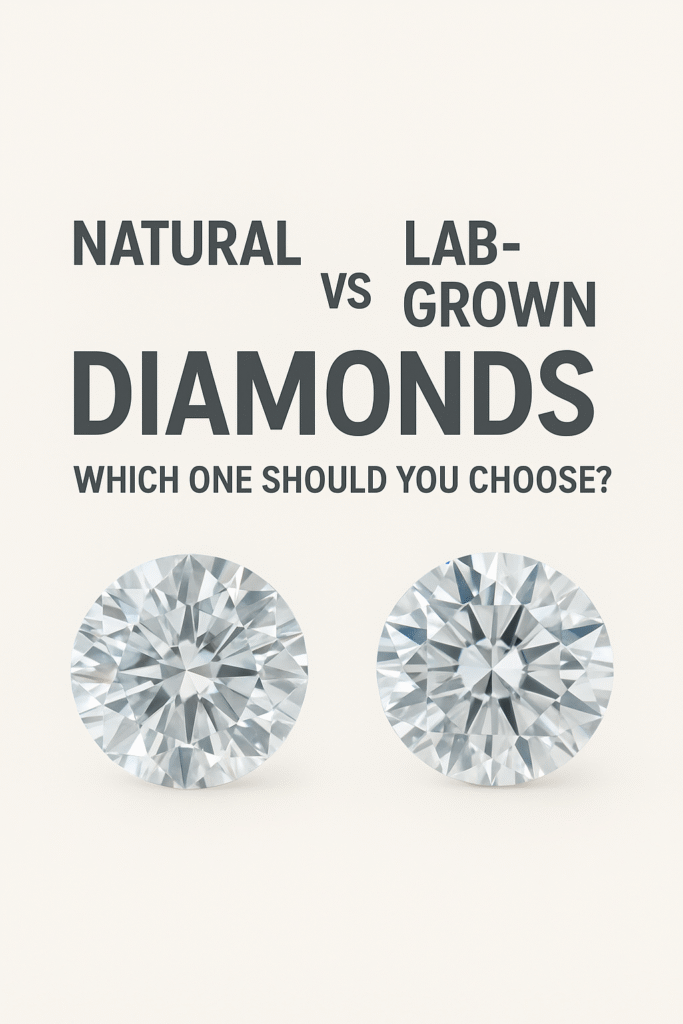
Natural vs Lab-Grown Diamonds: Choosing the right diamond is one of the most significant jewelry decisions you will ever make. Whether you are shopping for an engagement ring, anniversary gift, or a special treat for yourself, the debate between natural diamonds and lab-grown diamonds has never been more relevant.
Here is the challenge: both options look identical to the naked eye, share the same chemical composition, and offer stunning brilliance. Yet they differ dramatically in price, environmental impact, and long-term value. Many buyers feel overwhelmed by conflicting information and aggressive marketing from both sides.
This comprehensive guide cuts through the noise. You will learn exactly how natural and lab-created diamonds compare across every important factor, including cost, quality, ethics, durability, and resale value. By the end, you will have the knowledge to make a confident, informed decision that aligns with your values and budget.
What This Guide Covers
- How natural and lab-grown diamonds are formed
- Detailed price comparisons with real examples
- Quality grading and the 4Cs explained
- Ethics, sustainability, and environmental impact
- Investment and resale value analysis
- Popular diamond shapes and their characteristics
- Market trends and future predictions
- Complete buying checklist
- Expert tips and frequently asked questions
Understanding the Basics: What Are Natural and Lab-Grown Diamonds?
How Natural Diamonds Form
Natural diamonds form deep within the Earth’s mantle, approximately 100 to 150 miles below the surface. Under extreme pressure (around 725,000 pounds per square inch) and temperatures exceeding 2,000 degrees Fahrenheit, carbon atoms crystallize over billions of years to create these remarkable gemstones.
Volcanic eruptions then transport these diamonds closer to the Earth’s surface through kimberlite pipes. Mining operations extract them from these geological formations, after which they undergo cutting, polishing, and grading before reaching jewelry stores.
Each natural diamond is truly unique, carrying microscopic inclusions and characteristics that serve as a geological fingerprint. This natural formation process, spanning millions to billions of years, contributes significantly to their perceived rarity and value.
How Lab-Grown Diamonds Are Created
Lab-grown diamonds, also called synthetic diamonds, lab-created diamonds, or cultured diamonds, are produced in controlled laboratory environments. Scientists use two primary methods to replicate the natural diamond formation process in a matter of weeks rather than millions of years.
High Pressure High Temperature (HPHT) Method
The HPHT method mimics natural diamond formation conditions. A small diamond seed is placed in carbon material, then subjected to temperatures around 1,500 degrees Celsius and pressures of approximately 1.5 million pounds per square inch. The carbon melts and crystallizes around the seed, forming a larger diamond over several days to weeks.
HPHT diamonds often exhibit a slightly different crystal growth pattern than natural diamonds, which specialized equipment can detect. This method is particularly effective for producing colored diamonds, especially yellow and blue varieties.
Chemical Vapor Deposition (CVD) Method
CVD diamonds grow from a hydrocarbon gas mixture in a vacuum chamber. A thin diamond seed is placed inside, and the chamber is filled with carbon-rich gases like methane. When heated to around 800 degrees Celsius, the gases break down, and carbon atoms deposit onto the seed layer by layer, gradually building a diamond crystal.
CVD has become the dominant method for producing gem-quality lab diamonds because it allows for better control over the growth process and produces diamonds with fewer metallic inclusions than HPHT. Most colorless lab diamonds on the market today are CVD-grown.
Key Differences Between Natural and Lab-Grown Diamonds
Chemical and Physical Properties
This is perhaps the most important fact to understand: natural and lab-grown diamonds are chemically, physically, and optically identical. Both are pure carbon crystallised in an isometric cubic system. They share the same hardness (10 on the Mohs scale), refractive index (2.42), and thermal conductivity.
Professional gemologists cannot distinguish between them using standard equipment. Only specialized laboratory testing can identify a diamond’s origin by detecting trace elements or growth patterns specific to each formation method.
Comprehensive Side-by-Side Comparison
| Factor | Natural Diamond | Lab-Grown Diamond |
| Formation Time | 1-3 billion years | 2-6 weeks |
| Chemical Composition | Pure Carbon (C) | Pure Carbon (C) |
| Hardness (Mohs) | 10 | 10 |
| Refractive Index | 2.42 | 2.42 |
| Price (1ct, VS1, G) | $5,000-$12,000 | $800-$2,500 |
| Resale Value | 30-50% of retail | 10-20% of retail |
| Environmental Impact | Mining required | Energy-intensive |
| Supply | Limited by geology | Unlimited production |
| Certification | GIA, AGS, IGI | IGI, GCAL, GIA |
| Rarity | Geologically rare | Not rare |
| Price Trend | Relatively stable | Declining 15-30%/year |
Price Comparison: How Much Can You Save?
The price difference between natural and lab-grown diamonds is substantial and continues to widen. On average, lab-grown diamonds cost 60 to 80 percent less than natural diamonds of equivalent quality. This price gap has expanded dramatically as production technology improves and supply increases.
Real-World Price Examples by Carat Weight
To illustrate the savings, consider these approximate price comparisons for round brilliant diamonds with excellent cut grades:
| Specifications | Natural Price | Lab-Grown Price | Savings |
| 0.5ct VS1 G | $1,800-$3,000 | $400-$800 | ~75% |
| 1.0ct VS1 G | $6,500-$9,000 | $1,200-$2,500 | ~75% |
| 1.5ct VS2 F | $12,000-$18,000 | $2,000-$4,000 | ~80% |
| 2.0ct VS2 F | $18,000-$28,000 | $3,000-$6,000 | ~80% |
| 3.0ct VVS2 E | $45,000-$70,000 | $8,000-$15,000 | ~82% |
Why Such a Big Price Difference?
Several factors contribute to the price disparity:
- Supply control: Natural diamond supply is limited by geology and controlled by major mining companies. Lab diamonds can be produced in unlimited quantities.
- Production costs: Mining operations require massive infrastructure, environmental remediation, and extensive labor. Laboratory production is increasingly efficient.
- Market perception: Natural diamonds carry premium pricing due to perceived rarity and traditional marketing positioning them as symbols of eternal love.
- Declining lab diamond prices: As technology advances and competition increases, lab-grown diamond prices continue to drop, currently declining 15 to 30 percent annually.
What Your Budget Can Buy: Real Scenarios
Consider how different budgets translate into actual diamonds:
$3,000 Budget:
- Natural: 0.5-0.7 carat, VS2 clarity, G-H color
- Lab-Grown: 1.5-2.0 carat, VS1 clarity, E-F color
$5,000 Budget:
- Natural: 0.8-1.0 carat, VS2 clarity, G color
- Lab-Grown: 2.0-2.5 carat, VVS2 clarity, D-E color
$10,000 Budget:
- Natural: 1.2-1.5 carat, VS1 clarity, F-G color
- Lab-Grown: 3.0-4.0 carat, VVS1 clarity, D color
Quality and Grading: The 4Cs Explained
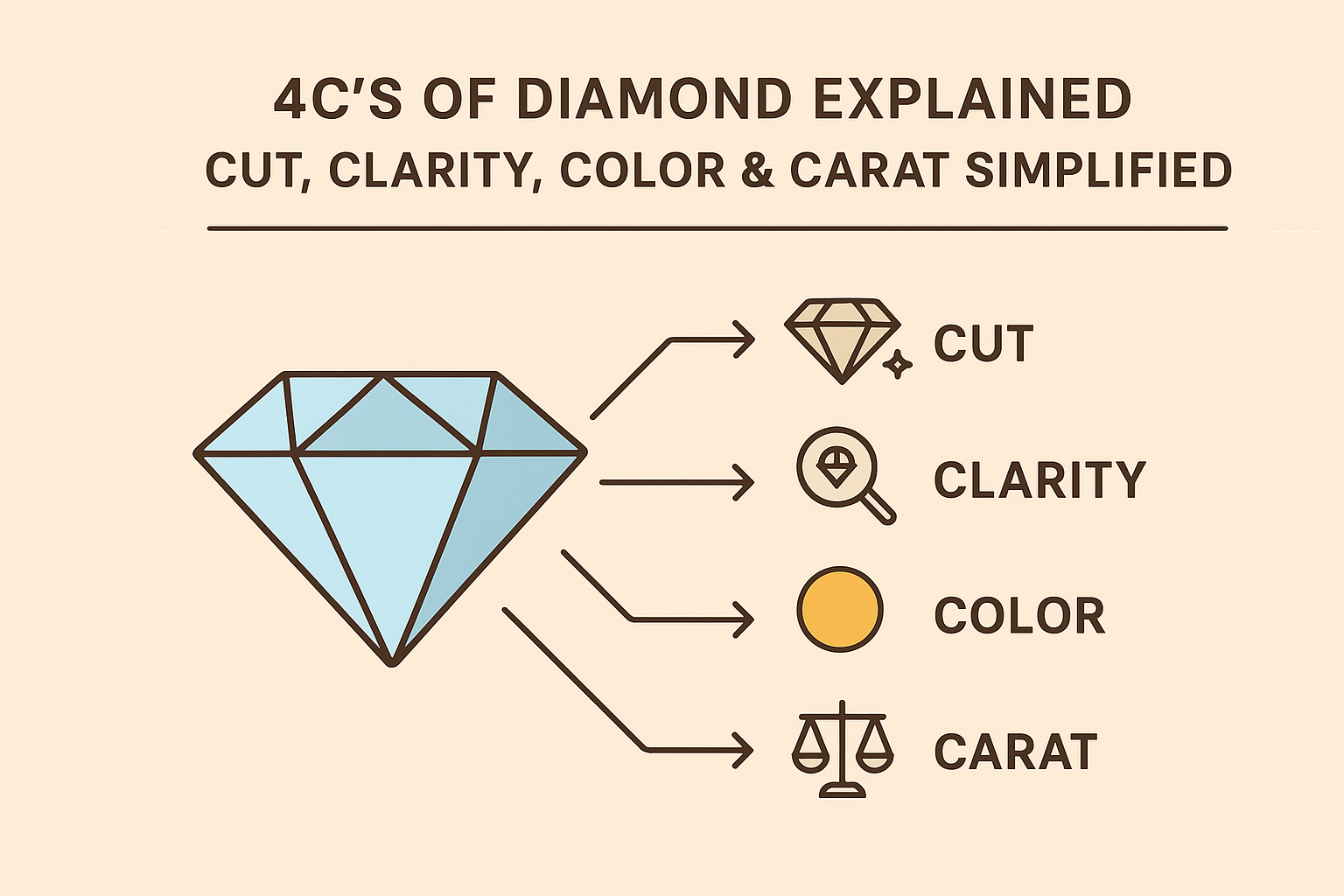
Both natural and lab-grown diamonds are evaluated using the same standardized grading criteria known as the 4Cs: Cut, Color, Clarity, and Carat weight. These universal standards ensure you can compare diamonds objectively regardless of their origin.
Cut: The Most Important Factor
Cut is the most important factor affecting a diamond’s beauty. It determines how well the stone reflects light, creating brilliance (white light reflection), fire (colored light dispersion), and scintillation (sparkle when moved). Cut grades range from Excellent/Ideal to Poor.
Both natural and lab diamonds can achieve Excellent or Ideal cut grades. Lab diamonds offer an advantage here because manufacturers can select optimal rough material for cutting, often resulting in a higher percentage of excellent cuts.
Pro Tip: Never compromise on cut quality. An Excellent cut diamond in G color will often appear more brilliant than a Poor cut diamond in D color. Prioritize cut above all other factors when budget is limited.
Color: From Colorless to Light Yellow
Diamond color is graded on a scale from D (completely colorless) to Z (light yellow or brown). The differences between adjacent grades are subtle and often imperceptible to untrained eyes.
- D-F (Colorless): Premium grades with no visible color. D is the rarest and most expensive.
- G-J (Near Colorless): Excellent value grades. Color is difficult to detect unless compared side-by-side with higher grades.
- K-M (Faint Yellow): Visible warmth. Can look beautiful in yellow gold settings.
- N-Z (Light Yellow): Noticeable yellow tint. Not typically used in engagement rings.
Lab-grown diamonds often achieve higher color grades more consistently because manufacturers can control growth conditions. Fancy colored diamonds (blues, pinks, yellows) are available in both categories, though lab-grown colored diamonds cost significantly less.
Clarity: Understanding Inclusions
Clarity measures the presence of internal inclusions and external blemishes visible under 10x magnification. Grades range from Flawless (FL) to Included (I1-I3).
- FL/IF (Flawless/Internally Flawless): No inclusions visible under 10x magnification. Extremely rare and expensive.
- VVS1/VVS2 (Very Very Slightly Included): Minute inclusions difficult for skilled graders to see under 10x.
- VS1/VS2 (Very Slightly Included): Minor inclusions observed with effort under 10x. Excellent value sweet spot.
- SI1/SI2 (Slightly Included): Inclusions noticeable under 10x, may be visible to naked eye in SI2.
- I1/I2/I3 (Included): Obvious inclusions visible to naked eye. May affect durability.
Natural diamonds typically contain mineral inclusions formed during their billion-year growth. Lab diamonds may contain different inclusions: metallic flux remnants in HPHT diamonds or graphite in CVD diamonds. Both types offer the full range of clarity grades.
Carat Weight: Size vs. Quality
Carat is a measure of weight, with one carat equaling 200 milligrams or 0.2 grams. Diamond prices increase exponentially with carat weight because larger diamonds are rarer.
Large natural diamonds are exponentially rarer and more expensive. Lab diamonds can be grown to any size, though very large specimens (over 5 carats) remain less common. Your budget will stretch significantly further with lab diamonds if size is a priority.
Smart Buying Tip: Consider buying just under popular carat thresholds (0.95ct instead of 1.0ct, 1.90ct instead of 2.0ct). These diamonds look nearly identical but cost significantly less due to pricing psychology.
Popular Diamond Shapes: Finding Your Perfect Cut
Diamond shape significantly impacts the stone’s appearance, brilliance, and perceived size. Both natural and lab-grown diamonds are available in all popular shapes, though some shapes offer better value than others.
Round Brilliant
The round brilliant is the most popular diamond shape, representing approximately 75% of all diamonds sold. Its 58 facets are mathematically designed to maximize light return and brilliance. Round diamonds command a 20-40% premium over fancy shapes due to higher demand and greater rough diamond waste during cutting.
Best for: Those who prioritize maximum sparkle and timeless elegance. Works beautifully in all settings.
Oval
Oval diamonds have surged in popularity, offering excellent brilliance similar to round diamonds but with an elongated shape that appears larger per carat. The elongation also creates a flattering, finger-lengthening effect.
Best for: Buyers wanting maximum perceived size and a modern, elegant look. Watch for the bow-tie effect (dark shadow across the center) when selecting.
Princess Cut
The princess cut is the second most popular shape after round. Its square silhouette with pointed corners offers contemporary style with excellent brilliance. It typically costs 20-30% less than equivalent round diamonds.
Best for: Those who love geometric shapes and want excellent value. Corners should be protected with prong settings.
Cushion Cut
Cushion cut diamonds feature rounded corners and larger facets that create a romantic, vintage appearance with soft, pillowy sparkle. Available in square or elongated rectangular shapes.
Best for: Lovers of vintage-inspired or romantic aesthetics. Excellent for halo settings.
Emerald Cut
The emerald cut is a step-cut diamond with a rectangular shape and long, open facets that create a hall-of-mirrors effect. It emphasizes clarity over brilliance, making high clarity grades more important.
Best for: Sophisticated buyers who prefer understated elegance over flashy sparkle. Looks stunning in Art Deco settings.
Pear Shape
Pear-shaped diamonds combine the brilliance of round cuts with a distinctive teardrop silhouette. The pointed end should point toward the fingertip when worn.
Best for: Those wanting a unique, eye-catching shape. Appears larger than equivalent carat weight rounds.
Diamond Shape Comparison
| Shape | Brilliance | Value | Size Appearance |
| Round | Excellent | Premium | True to carat |
| Oval | Excellent | Good | Appears larger |
| Princess | Very Good | Very Good | True to carat |
| Cushion | Good | Good | Slightly smaller |
| Emerald | Moderate | Excellent | Appears larger |
| Pear | Very Good | Good | Appears larger |
Ethics and Sustainability: Making a Responsible Choice
Environmental Considerations
The environmental debate is more nuanced than marketing suggests. Diamond mining undeniably impacts landscapes, requires significant water usage, and can harm local ecosystems. Open-pit mines can span miles and create lasting geological changes.
However, lab diamond production is energy-intensive. Creating a single carat can require 250 to 750 kilowatt-hours of electricity, depending on the method. The environmental footprint depends heavily on the energy source. Facilities powered by renewable energy have significantly lower carbon footprints than those using coal-powered grids.
Some lab diamond producers now offer carbon-neutral or carbon-negative diamonds through renewable energy use and offset programs. If environmental impact is your primary concern, research specific producers’ sustainability practices rather than assuming all lab diamonds are automatically greener.
Ethical Sourcing and Conflict-Free Certification
The term “blood diamond” or “conflict diamond” refers to stones mined in war zones and sold to finance armed conflict. The Kimberley Process, established in 2003, certifies rough diamonds as conflict-free, though critics argue the system has limitations and enforcement gaps.
Lab-grown diamonds completely bypass these concerns since they are created in controlled facilities with transparent supply chains. For buyers prioritizing ethical certainty, lab diamonds offer peace of mind.
However, many natural diamond companies now maintain rigorous tracking systems, including blockchain verification, and support mining communities through fair wages and development programs. Canadian and Australian diamonds, for example, are mined under strict environmental and labor regulations.
Supporting Mining Communities
An often-overlooked perspective: diamond mining provides livelihoods for approximately 10 million people worldwide, particularly in developing nations like Botswana, Namibia, and Sierra Leone. Responsible mining operations fund schools, hospitals, and infrastructure in remote communities. In Botswana, diamond revenues account for over 30% of GDP and have helped transform the country into one of Africa’s most stable economies. Choosing natural diamonds from ethical sources can support these communities. The decision involves weighing environmental impact against socioeconomic benefits.
Investment and Resale Value: Long-Term Considerations
If you are considering diamonds as an investment or want to understand resale potential, this section provides crucial insights often glossed over by retailers.
Natural Diamond Resale Reality
Despite marketing messages about diamonds being forever, natural diamonds typically lose 30 to 50 percent of their retail value immediately after purchase. Retail markups are substantial (often 100-200%), and the secondary market cannot support retail prices. Exceptions exist for rare colored diamonds (especially pink and blue), exceptional specimens over 5 carats, and diamonds with notable provenance.
That said, natural diamonds do maintain some residual value. A quality natural diamond purchased today will likely retain meaningful value decades from now, even if that value is less than the original purchase price. They can be traded in at jewelers, sold to estate buyers, or passed down as heirlooms.
Lab Diamond Resale Challenges
Lab-grown diamonds face significant resale challenges. Because production continues to increase and prices continue to fall (15-30% annually), a lab diamond purchased today may be worth a small fraction of its price in just a few years. Many jewelers do not accept lab diamonds for trade-in programs, and secondary market demand remains limited.
If resale value matters to you, natural diamonds are the better choice. If you view your purchase as a personal adornment rather than an investment, the lower upfront cost of lab diamonds may be more appealing.
Market Trends and Future Predictions
Current Market Dynamics
The diamond market is experiencing significant shifts. Lab-grown diamonds now account for approximately 10-15% of the engagement ring market in the United States and continue to gain market share rapidly. Major jewelry retailers including Signet, Brilliant Earth, and others have expanded their lab-grown offerings.
Meanwhile, natural diamond prices have remained relatively stable, though some softening has occurred in lower-quality categories. Premium natural diamonds, especially fancy colors and larger specimens, continue to appreciate.
Price Trajectory Predictions
Lab-grown diamonds: Prices are expected to continue declining as production efficiency improves and competition intensifies. Industry analysts predict lab diamonds could eventually reach commodity-level pricing, similar to other manufactured goods.
Natural diamonds: Prices are expected to remain stable or increase modestly for high-quality specimens. As easily accessible deposits become depleted and no major new discoveries emerge, supply constraints may support pricing long-term.
Consumer Trends
Several trends are shaping buyer preferences:
- Younger buyers: Millennials and Gen Z show stronger preference for lab-grown diamonds, citing cost savings and ethical considerations.
- Sustainability focus: Environmental consciousness is increasingly influencing purchasing decisions across all age groups.
- Value-seeking: More buyers are prioritizing visible quality (size and appearance) over origin.
- Customization: The savings from lab diamonds often fund more elaborate custom settings and designs.
Who Should Choose Natural Diamonds?
Natural diamonds may be the right choice if:
- You value the romantic symbolism of a stone formed over billions of years
- Resale value and long-term worth are important considerations
- You are purchasing for a milestone event where tradition matters
- You want to support responsible mining communities
- Budget is flexible and you prefer owning something with geological rarity
- You are shopping for rare colored diamonds or collector-grade specimens
- You plan to pass the jewelry down as a family heirloom
Who Should Choose Lab-Grown Diamonds?
Lab-grown diamonds may be the right choice if:
- Maximizing size and quality within your budget is the priority
- You want ethical certainty and supply chain transparency
- You prefer to invest your savings elsewhere (wedding, honeymoon, home down payment)
- You value technological innovation and modern choices
- Resale value is not a significant concern
- You want a beautiful, real diamond without the premium pricing
- You are purchasing fashion jewelry or secondary pieces
Complete Diamond Buying Checklist
Use this comprehensive checklist to ensure you make a confident, informed purchase whether choosing natural or lab-grown diamonds.
Before You Shop
- Set a realistic budget including the setting cost
- Decide on natural vs. lab-grown based on your values
- Research preferred diamond shapes
- Determine minimum acceptable quality grades
- Research reputable retailers with good return policies
When Evaluating Diamonds
- Request certification from GIA, AGS, IGI, or GCAL
- Verify the certificate matches the diamond
- Prioritize Excellent or Ideal cut grades
- View the diamond under different lighting conditions
- Check for eye-visible inclusions in SI grades
- Compare equivalent specs across multiple retailers
- Ask about fluorescence and its impact
Before Purchasing
- Confirm the return policy (30 days minimum recommended)
- Verify warranty terms for the setting
- Ask about complimentary services (cleaning, inspections)
- Confirm insurance appraisal availability
- Get itemized pricing for diamond and setting
- Request secure, insured shipping for online orders
After Purchase
- Get an independent appraisal for insurance
- Add the jewelry to your insurance policy
- Store certification and appraisal securely
- Schedule regular professional inspections
- Learn proper cleaning and care techniques
Expert Tips for Buying Either Type of Diamond
Always Request Certification
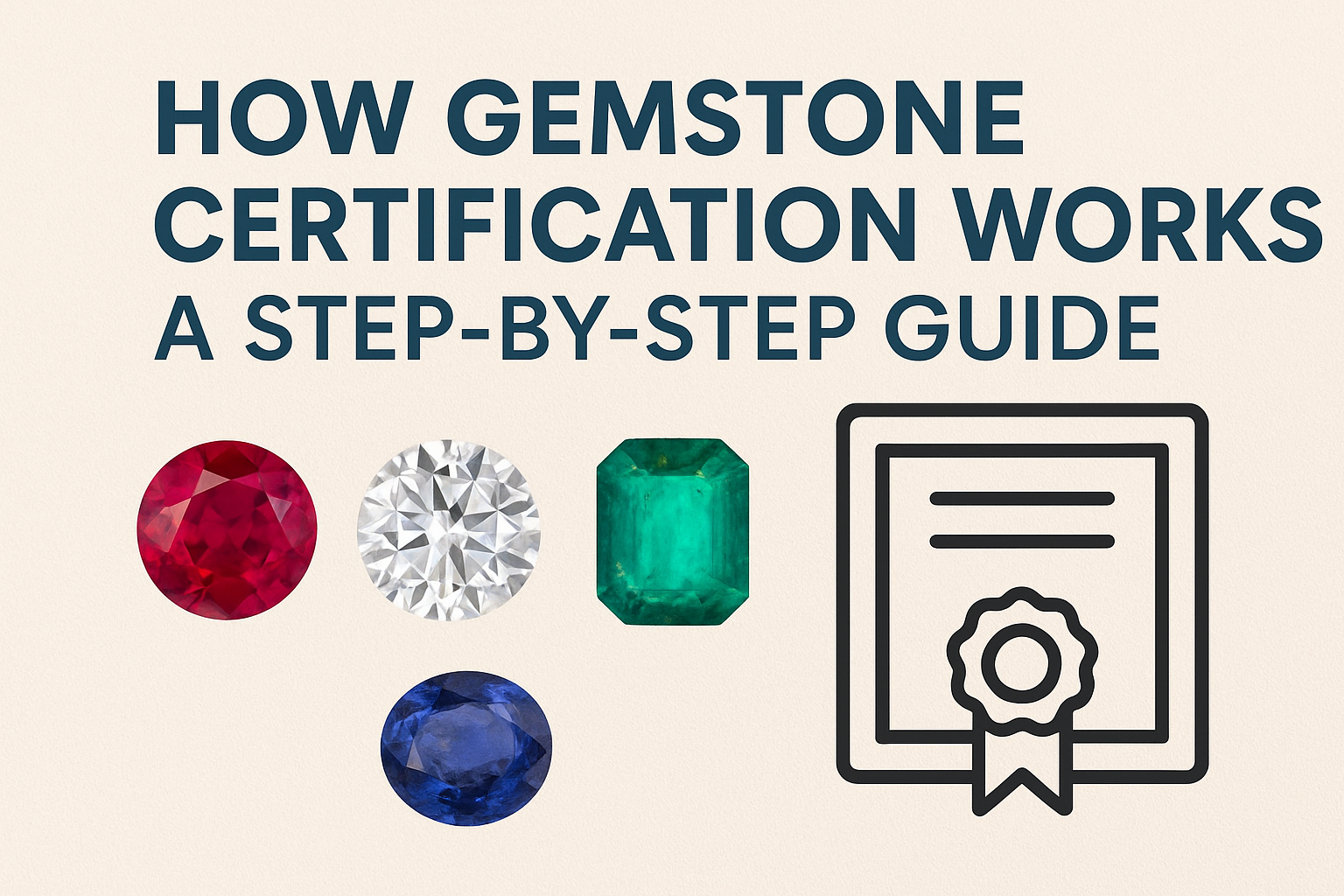
Never purchase a diamond without certification from a reputable laboratory. For natural diamonds, GIA (Gemological Institute of America) and AGS (American Gem Society) are the gold standards. For lab-grown diamonds, IGI (International Gemological Institute) and GCAL (Gem Certification and Assurance Lab) are well-respected. The certificate verifies the 4Cs and, crucially, confirms whether the diamond is natural or lab-grown.
Prioritize Cut Quality
An excellent cut can make a lower color or clarity grade appear more brilliant. Budget-conscious buyers should prioritize cut above all other factors. A well-cut G color, VS2 clarity diamond often looks better than a poorly cut D color, VVS1 diamond.
Compare Multiple Retailers
Diamond pricing varies significantly between retailers. Online vendors typically offer 20-40% better prices than traditional brick-and-mortar stores due to lower overhead costs. Compare equivalent specifications across multiple sellers and check reviews before purchasing.
View Diamonds in Person When Possible
While online shopping offers convenience and savings, seeing a diamond in person allows you to evaluate its appearance under different lighting conditions. Many online retailers offer viewing appointments or virtual consultations. If purchasing online, ensure the retailer has a generous return policy of at least 30 days.
Consider the Setting
The right setting can enhance a diamond’s appearance. Halo settings make center stones appear larger. Bezel settings protect vulnerable corners on princess and marquise cuts. Yellow gold settings can mask slight warmth in lower color grades. Factor setting costs into your total budget, as elaborate settings can add $500 to $3,000 or more.
Final Verdict: Making Your Decision
The choice between natural and lab-grown diamonds ultimately comes down to your personal values, priorities, and budget. There is no objectively right answer, only the right answer for you.
If you prioritize tradition, potential resale value, and owning something with geological significance, natural diamonds remain a compelling choice. If you want maximum visual impact for your budget, ethical certainty, and view jewelry as personal rather than an investment, lab-grown diamonds offer exceptional value.
Remember that both options are real diamonds with identical physical properties. Both will sparkle brilliantly, last forever with proper care, and symbolize your commitment or celebration.
Ready to start shopping? Use this guide as your reference while comparing options. Request certifications, prioritize cut quality, and choose the diamond that makes you happy every time you see it sparkle.
Frequently Asked Questions
Can jewelers tell the difference between natural and lab-grown diamonds?
Standard jeweler equipment cannot distinguish between natural and lab-grown diamonds because they are chemically identical. However, specialized laboratory testing can identify origin through microscopic growth patterns, trace elements, and fluorescence characteristics. Most lab-grown diamonds are laser-inscribed on the girdle with a microscopic identification number for verification.
Do lab-grown diamonds lose their sparkle or degrade over time?
No. Lab-grown diamonds are structurally identical to natural diamonds and will maintain their brilliance indefinitely. They have the same hardness (10 on the Mohs scale) and will not cloud, fade, or change color. With proper care, a lab-grown diamond will look exactly the same in 100 years as it does today.
Will insurance companies cover lab-grown diamond jewelry?
Yes, most insurance companies cover lab-grown diamond jewelry just like natural diamond pieces. Coverage is typically based on the appraised replacement value. Be sure to get an independent appraisal and inform your insurance provider about the diamond’s origin, as replacement costs differ significantly between natural and lab-grown stones. Update your appraisal every few years, as lab diamond prices continue to decline.
Are there any maintenance differences between natural and lab diamonds?
There are no maintenance differences. Both types require the same care: regular cleaning with mild soap and warm water using a soft brush, professional inspections every six to twelve months to check prong security, and avoiding exposure to harsh chemicals like bleach or chlorine. Both can be safely cleaned ultrasonically. Store diamond jewelry separately from other pieces to prevent scratching softer gemstones.
Should I tell my partner if I buy a lab-grown diamond for an engagement ring?
Honesty is always the best policy in relationships. Many couples today discuss diamond preferences together before purchasing. Some partners specifically prefer lab-grown diamonds for ethical or environmental reasons, while others may value natural diamonds for traditional symbolism. Having this conversation beforehand shows respect and ensures the ring aligns with both partners’ values and expectations.
What happens to lab-grown diamond prices in the future?
Lab-grown diamond prices have been declining steadily, dropping approximately 15-30% annually as production technology improves and competition increases. This trend is expected to continue. While this makes lab diamonds increasingly affordable, it also means diamonds purchased today will likely be worth less in the future. This is an important consideration if resale value matters to you.
Can I upgrade from a lab-grown diamond to a natural diamond later?
Most jewelers that offer upgrade programs do not allow cross-upgrading between lab-grown and natural diamonds. Lab diamonds typically cannot be traded toward natural diamonds. However, some retailers offer lab-to-lab upgrade programs. If future upgrades are important to you, verify the retailer’s specific policies before purchasing. Alternatively, you could sell the lab diamond privately and purchase a natural diamond separately.
Are lab-grown diamonds considered “real” diamonds?
Yes, lab-grown diamonds are real diamonds. They have the same chemical composition (pure carbon), crystal structure, optical properties, and physical hardness as natural diamonds. The Federal Trade Commission (FTC) recognizes lab-grown diamonds as real diamonds. The only difference is their origin: one formed in the Earth over billions of years, while the other was created in a laboratory over weeks. Both are genuine diamonds, not simulants like cubic zirconia or moissanite.
Which diamond type is better for everyday wear?
Both natural and lab-grown diamonds are equally suitable for everyday wear. Both have a hardness of 10 on the Mohs scale, making them the most durable gemstone available and resistant to scratching. Both will maintain their appearance indefinitely with normal wear. The choice between them for daily wear should be based on budget, values, and personal preference rather than durability concerns.
How do I know if a retailer is selling lab-grown diamonds as natural?
Always purchase from reputable retailers and request certification from recognized laboratories (GIA, AGS, IGI, or GCAL). The certificate will clearly state whether the diamond is natural or laboratory-grown. Additionally, most lab-grown diamonds have a microscopic laser inscription on the girdle identifying them as lab-created. If a deal seems too good to be true for a natural diamond, it may actually be a lab-grown stone being misrepresented. When in doubt, have an independent gemologist verify the diamond before purchase.
Disclaimer: This guide is for informational purposes only. Diamond prices fluctuate based on market conditions. Always conduct your own research and consult with certified gemologists before making significant purchases. Price ranges mentioned are approximate and may vary by retailer and location.