
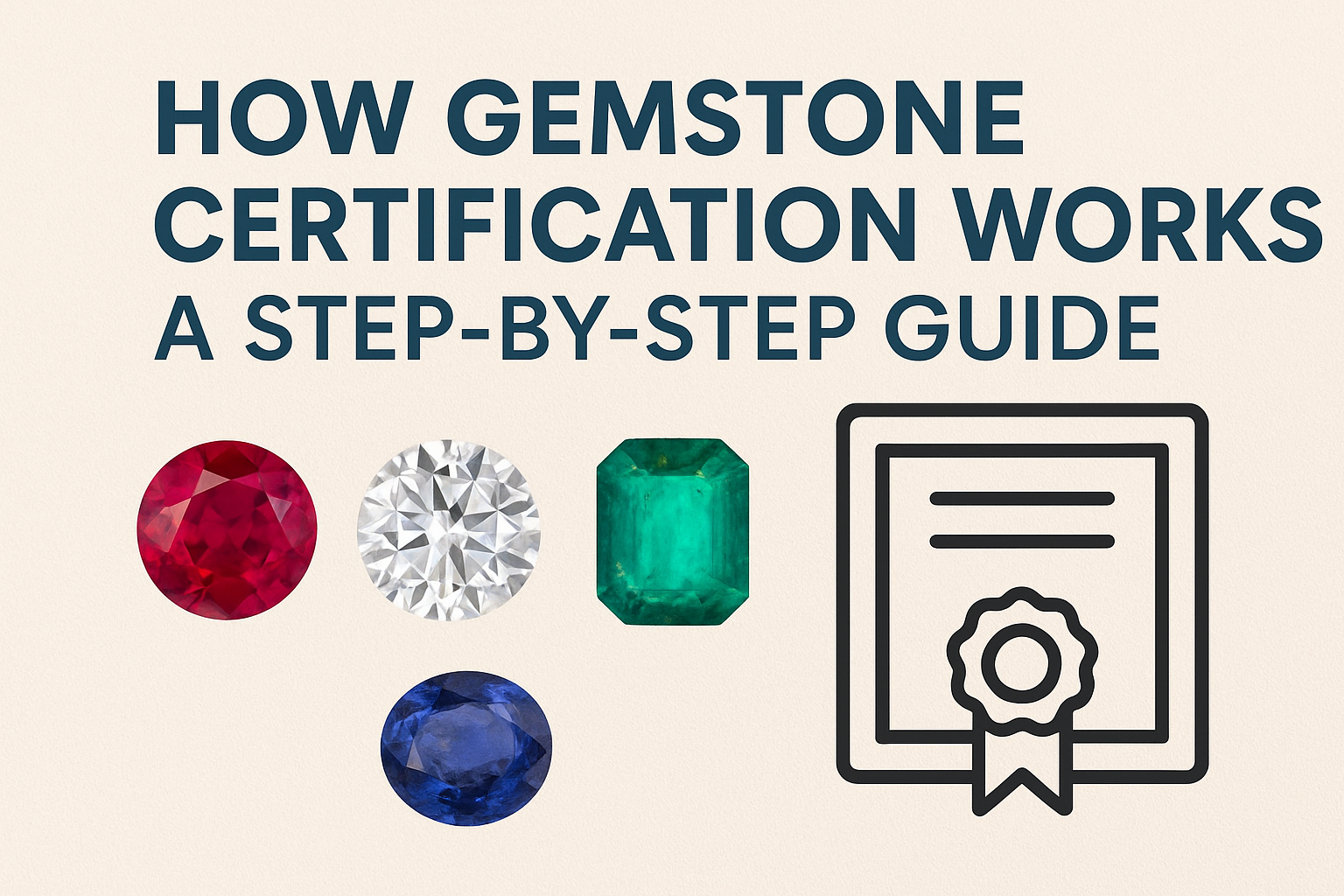
Buying a gemstone without certification is like purchasing a house without an inspection—you simply don’t know what you’re getting. Whether you’re investing in a stunning ruby engagement ring, adding a rare sapphire to your collection, or selecting the perfect emerald as a family heirloom, understanding gemstone certification is essential for making an informed purchase.
The gemstone market presents unique challenges for buyers. Unlike manufactured products with standardized specifications, natural gemstones vary dramatically in quality, origin, and value. A certificate from a reputable gemological laboratory provides the objective assessment needed to verify authenticity, understand quality characteristics, and ensure you’re paying a fair price.
In this comprehensive guide, we’ll walk you through every step of the gemstone certification process, explain what certificates contain, help you choose the right laboratory, and show you how to verify your gemstone’s documentation. By the end, you’ll have the knowledge to confidently navigate the world of certified precious stones.
What Is Gemstone Certification?
Gemstone certification is a formal evaluation and documentation process conducted by trained gemologists using specialized equipment and standardized grading criteria. When a gemstone undergoes certification, expert gemologists examine it thoroughly to determine its identity, quality characteristics, origin, and whether any treatments have been applied.
The resulting certificate—also called a gem report or grading report—serves as an independent, third-party assessment of the stone’s properties. This document provides crucial information that helps buyers understand exactly what they’re purchasing and serves as documentation for insurance, resale, and estate purposes.
Why Certification Matters for Buyers and Sellers
Certification benefits all parties in a gemstone transaction:
For Buyers: A certificate provides confidence that you’re receiving what the seller claims. It documents the gemstone’s quality characteristics objectively, allowing you to compare stones accurately and make informed purchasing decisions. Certificates also protect your investment by providing documentation for insurance coverage.
For Sellers: Offering certified gemstones builds trust with customers and can justify premium pricing for high-quality stones. Certification removes subjectivity from the sales process and provides documentation that protects against disputes.
For Collectors and Investors: Certification establishes provenance and quality documentation that maintains a gemstone’s value over time. Certified stones are easier to resell, insure, and include in estate planning.
Certificate vs. Appraisal: Understanding the Difference
Many people confuse gemstone certificates with appraisals, but these serve different purposes. A gemstone certificate describes the physical characteristics and quality of a stone but does not assign a monetary value. It tells you what the gemstone is. An appraisal, on the other hand, assigns a specific dollar value to a piece of jewelry or loose stone, typically for insurance purposes. Many appraisers rely on existing certificates as part of their valuation process, but the two documents serve distinct functions.
Major Gemological Laboratories and Their Standards
Not all gemstone certificates carry equal weight in the marketplace. The credibility of a certificate depends entirely on the reputation and standards of the issuing laboratory. Here are the most respected gemological laboratories worldwide:
GIA (Gemological Institute of America)
Founded in 1931, the Gemological Institute of America is widely considered the gold standard in gemstone certification. GIA created the 4Cs grading system for diamonds that the entire industry now uses. Their colored gemstone reports are equally respected for their accuracy and consistency. GIA operates as a nonprofit organization, which enhances their reputation for impartiality. They maintain laboratories in multiple countries and are particularly known for their rigorous testing protocols and conservative grading standards.
AGS (American Gem Society)
The American Gem Society Laboratories is another highly respected certification body, particularly known for their advanced cut grading methodology. AGS developed their own 0-10 grading scale and provides extensive light performance analysis for diamonds. Their reports are especially valued by buyers who prioritize optical performance and cut quality.
Gübelin Gem Lab
Based in Switzerland, Gübelin Gem Lab is one of the world’s premier authorities on colored gemstones. They are particularly renowned for their expertise in origin determination and treatment detection for rubies, sapphires, and emeralds. Gübelin certificates are highly valued in the high-end colored gemstone market, and their Provenance Proof blockchain-based tracking system represents cutting-edge innovation in gemstone documentation.
SSEF (Swiss Gemmological Institute)
SSEF is another Swiss laboratory with exceptional expertise in colored gemstone analysis. They are particularly respected for their advanced research into gemstone treatments and origins. SSEF reports are commonly requested for high-value colored stones, especially at auction houses and among serious collectors.
IGI (International Gemological Institute)
With laboratories across multiple continents, IGI is one of the largest gemological organizations worldwide. They certify both natural and laboratory-grown diamonds, as well as colored gemstones. IGI reports are commonly found in retail jewelry stores and provide a good balance of thoroughness and accessibility.
Laboratory Comparison at a Glance
| Laboratory | Specialty | Best For | Turnaround |
| GIA | Diamonds, all gemstones | Industry standard reports | 5-10 business days |
| AGS | Diamond cut analysis | Light performance data | 7-14 business days |
| Gübelin | Colored gemstones | High-value colored stones | 10-20 business days |
| SSEF | Origin & treatment analysis | Auction & collector pieces | 14-21 business days |
| IGI | All gemstones, lab-grown | Retail jewelry | 3-7 business days |
The Step-by-Step Gemstone Certification Process
Understanding how gemological laboratories evaluate and certify gemstones helps you appreciate the thoroughness of professional certification. Here’s a detailed look at each stage of the process:
Step 1: Submission and Initial Intake
The certification journey begins when you submit your gemstone to a laboratory. Most major labs accept submissions through authorized dealers, by mail with proper insurance, or at walk-in locations where available. During intake, the laboratory assigns a unique tracking number, photographs the gemstone, and records its initial measurements and weight. The stone is then placed in a secure, climate-controlled environment awaiting examination.
Step 2: Gemstone Identification and Authentication
The first technical step involves confirming exactly what the gemstone is. Gemologists use multiple instruments to verify the stone’s identity, including refractometers to measure refractive index, spectroscopes to analyze light absorption patterns, and specific gravity measurements. These tests distinguish natural gemstones from simulants, synthetics, and other materials. For example, a colorless stone might be diamond, white sapphire, moissanite, or cubic zirconia—each with distinct optical and physical properties.
Step 3: Natural vs. Laboratory-Grown Determination
Modern technology can create gemstones in laboratories that are chemically and optically identical to their natural counterparts. Distinguishing between natural and lab-grown stones requires sophisticated equipment like advanced spectroscopy, specialized microscopy, and fluorescence analysis. Natural gemstones contain unique inclusions, growth patterns, and trace elements that differ from their laboratory-created equivalents. This determination significantly impacts value, as natural gemstones typically command premium prices.
Step 4: Treatment Detection and Disclosure
Most gemstones on the market have undergone some form of treatment to enhance their appearance. Common treatments include heat treatment to improve color, fracture filling to reduce visibility of cracks, and diffusion to add or enhance color. Reputable laboratories use advanced techniques like FTIR spectroscopy, UV-Vis-NIR spectroscopy, and photoluminescence analysis to detect these treatments. Full disclosure of any treatments is essential, as it significantly affects value and durability.
Step 5: Quality Grading and Assessment
Once identification and treatment detection are complete, gemologists assess the stone’s quality characteristics:
- Color: Evaluated for hue (the basic color), saturation (intensity), and tone (lightness or darkness). For colored gems, the most valuable stones exhibit vivid saturation with medium tone.
- Clarity: Examined under magnification to identify inclusions and blemishes. Different gem species have different clarity expectations—emeralds commonly contain inclusions while aquamarines are typically eye-clean.
- Cut: Assessed for proportions, symmetry, and polish quality. Well-cut stones maximize brilliance, fire, and overall visual appeal.
- Carat Weight: Precisely measured using calibrated scales accurate to hundredths of a carat. Weight is expressed in metric carats (200 milligrams per carat).
Step 6: Origin Determination (When Requested)
For many colored gemstones, geographic origin significantly impacts value. Kashmir sapphires, Burmese rubies, and Colombian emeralds command premium prices due to their historical reputation and distinctive characteristics. Origin determination involves analyzing trace element chemistry, inclusion patterns, and growth features that vary by deposit. This specialized testing requires extensive reference databases and is typically offered as an additional service.
Step 7: Documentation and Report Generation
After all testing is complete, the laboratory compiles findings into a formal report. This document includes photographs, measurements, grading results, and any relevant comments about the stone’s characteristics. Modern certificates often include security features like holograms, unique report numbers, and QR codes linking to online verification systems. The gemstone is then securely packaged and returned to the client along with the certificate.
What Information Does a Gemstone Certificate Include?
A comprehensive gemstone certificate contains detailed information that fully characterizes the stone. Understanding each element helps you interpret reports accurately:
Identification Information
- Report Number: Unique identifier for verification purposes
- Date of Issue: When the examination was completed
- Gemstone Species and Variety: Scientific identification (e.g., corundum – ruby)
- Natural or Laboratory-Grown: Clear disclosure of origin type
Physical Measurements
- Weight: Expressed in carats to two decimal places
- Dimensions: Length, width, and depth in millimeters
- Shape and Cut Style: Round brilliant, oval, cushion, emerald cut, etc.
Quality Grades
- Color Grade: Description or grade of hue, saturation, and tone
- Clarity Grade: Assessment of inclusions and blemishes
- Cut Grade: Evaluation of proportions and craftsmanship (when applicable)
- Transparency: Transparent, translucent, or opaque
Treatment Disclosure
Certificates must disclose any detected treatments using industry-standard terminology. Common entries include “No indications of heat treatment,” “Indications of heat treatment,” “Minor clarity enhancement,” or specific treatment types like “Beryllium diffusion detected.” Understanding treatment disclosure is crucial because it directly impacts value and care requirements.
Additional Features
- Photographs: High-quality images showing the stone’s appearance
- Plotting Diagrams: Visual map of inclusions (primarily for diamonds)
- Comments: Notable characteristics or observations
- Security Features: Holograms, microprinting, and verification codes
How to Get Your Gemstone Certified
If you own an uncertified gemstone and want professional documentation, here’s how to proceed:
Choosing the Right Laboratory
Consider these factors when selecting a certification laboratory:
- Gemstone Type: Some labs specialize in certain stones. Gübelin and SSEF excel with colored gemstones, while GIA and AGS are definitive for diamonds.
- Value and Purpose: High-value stones benefit from premium laboratory reports. For insurance documentation, widely recognized labs like GIA provide the clearest accepted standards.
- Geographic Convenience: Using a nearby laboratory reduces shipping risks and may speed turnaround time.
- Budget: Certification costs vary by laboratory, services requested, and gemstone size. Basic reports start around $50-100, while comprehensive colored stone reports with origin determination can exceed $300-500.
Submission Process
- Complete the laboratory’s submission form with your contact information and service requests.
- Package your gemstone securely using padded containers and tamper-evident sealing.
- Ship via insured carrier with tracking, signature confirmation, and appropriate declared value.
- Track your submission online using the laboratory’s portal.
- Receive your certified gemstone and report via secure return shipping.
Typical Costs and Timeframes
| Service Type | Typical Cost | Turnaround |
| Diamond Grading Report | $80 – $200 | 5-10 days |
| Colored Stone Report | $100 – $250 | 7-14 days |
| Origin Determination | $150 – $400+ | 14-21 days |
| Rush Service | Additional 50-100% | 1-3 days |
How to Verify a Gemstone Certificate Is Authentic
Unfortunately, fraudulent certificates do exist. Knowing how to verify authenticity protects your investment:
Online Verification Systems
All major laboratories maintain online databases where you can verify certificates by entering the report number. GIA’s Report Check, AGS’s Document Verification, and similar systems display the complete report data, allowing you to confirm the certificate matches the laboratory’s records. Any discrepancies between the physical certificate and online records should raise immediate concerns.
Physical Security Features
Authentic certificates include multiple security features:
- Holographic seals that change appearance when tilted
- Microprinting visible only under magnification
- UV-reactive inks and watermarks
- QR codes linking to verification portals
- Embossed or raised seals
Matching the Stone to the Certificate
Verifying the certificate is genuine is only half the process—you must also confirm the certificate actually belongs to the gemstone in question. Check that the weight, measurements, and described characteristics match the actual stone. For diamonds, compare the inclusion pattern to any plotting diagrams. For laser-inscribed stones, examine the girdle inscription with magnification to confirm it matches the report number.
Red Flags and Warning Signs
Be wary of certificates that show these concerning indicators:
- Unfamiliar laboratory names without verifiable credentials
- No online verification system available
- Poor print quality or missing security features
- Measurements or weights that don’t match the actual stone
- Certificates from “laboratories” that grade unusually high
Special Certification Considerations by Gemstone Type
Diamond Certification
Diamond certification follows the most standardized protocols in the industry. The 4Cs system—Color, Clarity, Cut, and Carat weight—provides a universal framework for evaluation. Diamond certificates typically include detailed plotting diagrams showing inclusion locations and types. Cut grading for round brilliant diamonds has become particularly sophisticated, with proportions, symmetry, and polish all evaluated. Modern certificates also distinguish between natural and laboratory-grown diamonds, which is essential given the identical appearance of high-quality lab-created stones.
Colored Gemstone Certification
Colored stones present unique certification challenges because each species has different quality expectations. Emeralds are almost always included, sapphires frequently undergo heat treatment, and color grading is more subjective than for colorless diamonds. Origin determination adds significant value for certain colored stones—a certificate confirming Burmese origin for a ruby or Colombian origin for an emerald substantially increases market value. Treatment detection is particularly important for colored gems, as common treatments like heating, fracture filling, and diffusion dramatically affect value.
Pearl Certification
Pearl certification differs from crystalline gemstones because pearls have unique quality factors. Certificates evaluate nacre quality, luster, surface condition, shape, and size. For strands, matching and graduation quality are also assessed. Origin matters significantly—South Sea, Tahitian, and Akoya pearls each have distinct characteristics and value ranges. Distinguishing natural from cultured pearls requires x-ray examination of internal structure.
Laboratory-Grown Gemstone Certification
As laboratory-created gemstones become increasingly common, proper certification is essential for transparency. Reputable laboratories clearly identify lab-grown stones and describe the growth method (HPHT, CVD, flux, or hydrothermal). Quality grading applies the same standards as natural stones, but the natural vs. synthetic determination is prominently disclosed. Many retailers now offer lab-grown options with full certification, providing documentation comparable to natural stone reports.
Why Buying Certified Gemstones Is Worth the Investment
Confidence in Quality and Authenticity
A certificate from a respected laboratory eliminates guesswork about what you’re purchasing. You know the stone’s exact characteristics, any treatments applied, and whether it’s natural or laboratory-created. This transparency enables informed decision-making and protects against misrepresentation.
Easier Price Comparison
Standardized grading allows direct comparison between gemstones from different sellers. Without certification, comparing a “high-quality sapphire” from one vendor to a “premium sapphire” from another is essentially impossible. Certificates provide the common language needed for accurate price comparison.
Insurance and Documentation Benefits
Insurance companies require documentation to properly cover valuable gemstones. A certificate from a recognized laboratory streamlines the insurance process and ensures adequate coverage. In case of loss or theft, the detailed certificate documentation helps establish value and aids in recovery identification.
Resale Value Protection
Certified gemstones command higher resale prices than uncertified stones of similar quality. The certificate provides third-party validation that potential buyers trust, making sales faster and easier. For estate planning purposes, certified gems are simpler to divide and value accurately.
Final Thoughts: Making Certification Work for You
Gemstone certification represents the intersection of science, expertise, and consumer protection in the jewelry industry. Whether you’re purchasing your first diamond engagement ring or adding to a serious gemstone collection, understanding how certification works empowers you to make better decisions and protect your investment.
The key takeaways from this guide include recognizing which laboratories are most respected for different types of gemstones, understanding what each step of the certification process entails, knowing what information certificates should contain, and being able to verify certificate authenticity. Armed with this knowledge, you can confidently navigate the gemstone market.
For significant gemstone purchases, always insist on certification from a recognized laboratory. The modest cost of professional certification is a small price to pay for the confidence, documentation, and protection it provides. When in doubt, choose laboratories with the strongest reputations—GIA for diamonds and general gemstones, and specialized labs like Gübelin or SSEF for high-value colored stones requiring origin determination.
Ready to get started? Research certified gemstones from reputable dealers, verify any certificates before purchasing, and don’t hesitate to ask questions. Your perfect gemstone—backed by reliable documentation—is waiting to be discovered.
Frequently Asked Questions About Gemstone Certification
Can I get a gemstone certified if it’s already set in jewelry?
Yes, many laboratories offer mounted stone services that can examine gemstones while they remain in their settings. However, there are limitations—some measurements and tests cannot be performed accurately when a stone is mounted. For the most comprehensive certification, particularly for high-value stones, laboratories may recommend removing the gemstone from its setting temporarily. Discuss your specific situation with the laboratory before submission to understand what services are available for mounted pieces.
How often should I have my gemstones re-certified?
Gemstone certificates don’t expire because the inherent characteristics of a stone don’t change over time. However, re-certification might be valuable if you’re planning to sell a stone certified many years ago (to reflect current grading standards), if you want updated documentation for insurance purposes, or if you suspect the stone may have been damaged or altered since the original certification. For insurance, many companies accept certificates that are several years old, but some may request updated appraisals periodically.
Do all jewelers accept certificates from any laboratory?
While certificates from top-tier laboratories like GIA, AGS, Gübelin, and SSEF are universally respected, some regional or lesser-known laboratories may not be accepted by all jewelers or insurance companies. This matters particularly for resale situations—a stone certified by an obscure laboratory may be harder to sell or may require re-certification by a recognized lab before a dealer will make an offer. When in doubt, stick with internationally recognized laboratories to ensure your documentation is accepted everywhere.
What should I do if my gemstone grades differently from what the seller claimed?
If you have a gemstone independently certified and the results differ significantly from the seller’s claims, you may have grounds for return or refund depending on the purchase agreement. Document everything carefully, including the original sales claims and the independent laboratory results. Contact the seller with your findings before taking further action. Reputable sellers typically honor returns when independent certification reveals misrepresentation. If the seller refuses to cooperate, consider consulting consumer protection resources or legal counsel for significant purchases.
Is blockchain-based gemstone certification reliable?
Blockchain technology is emerging as a supplementary tool for gemstone documentation, with laboratories like Gübelin pioneering systems that track a stone’s journey from mine to market. Blockchain provides an immutable record that can prove provenance and ownership history. However, blockchain certification works best in combination with traditional laboratory certification—it documents the chain of custody but doesn’t replace the scientific analysis that determines quality and authenticity. Think of blockchain as an enhanced tracking system that adds an extra layer of verification to traditional certification, not a replacement for it.