

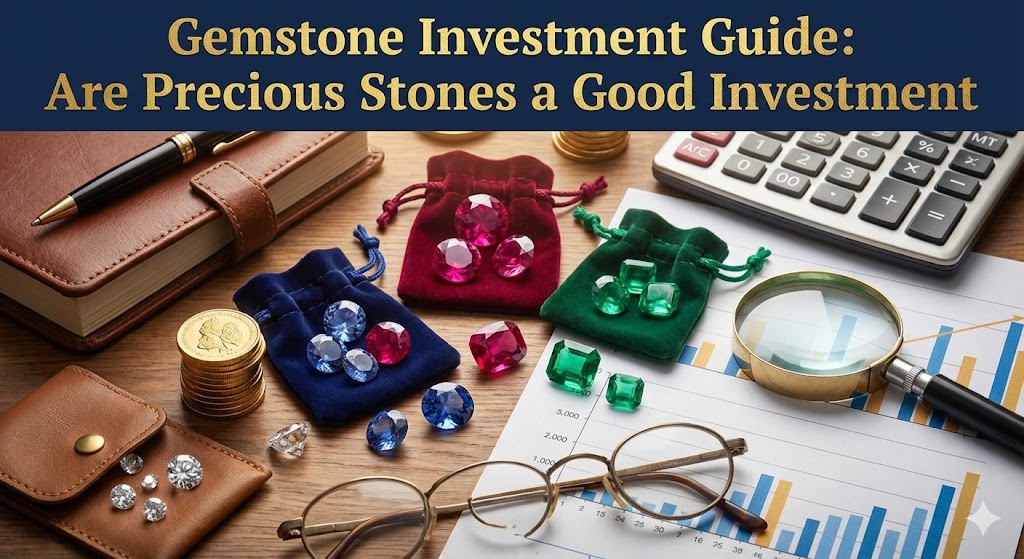
Are you looking for alternative investments that sparkle with potential? With the global gemstone market valued at approximately $36 billion in 2025 and projected to reach $68 billion by 2035, precious stones have captured the attention of savvy investors worldwide.
While stocks fluctuate and real estate requires significant capital, gemstones offer a unique combination of tangible beauty and long-term value appreciation. But are precious stones truly a smart investment choice, or just another glittering temptation?
In this comprehensive guide, we’ll explore everything you need to know about gemstone investing—from understanding market dynamics and identifying the best stones for investment to navigating risks and maximizing returns. Whether you’re a seasoned investor or just starting your journey into alternative assets, this guide will help you make informed decisions.
Understanding the Gemstone Investment Market
Current Market Overview and Growth Projections
The global gemstone industry has demonstrated remarkable resilience, growing steadily even through economic uncertainties. According to market research, the industry is expanding at a compound annual growth rate (CAGR) of 5.7% to 6.6%, depending on the segment analyzed.
Key market statistics for 2025 include:
- Global market value: Approximately $36 billion
- Projected 2035 value: $68 billion (representing 89% growth)
- Colored gemstone market share in bridal jewelry: 15%
- Investment-grade gems annual appreciation: 5-15% on average
Why Investors Are Turning to Precious Stones
Several factors are driving increased investor interest in gemstones as an asset class:
- Portfolio Diversification: Gemstones have minimal correlation with traditional financial markets, providing a hedge during economic downturns.
- Tangible Asset Security: Unlike digital assets, gemstones are physical items you can hold, store, and pass down through generations.
- Inflation Hedge: Precious stones have historically maintained or increased their value during inflationary periods.
- Growing Global Demand: Markets in China, India, and the Middle East are driving unprecedented demand for colored gemstones.
Best Gemstones for Investment: The Big Three and Beyond
Ruby: The King of Colored Gemstones
Rubies consistently rank as the most valuable colored gemstones, with exceptional specimens commanding prices exceeding $1 million per carat at auction. Their investment appeal stems from extreme rarity, especially for untreated stones with the coveted “pigeon’s blood” coloration.
Investment Characteristics:
- Average annual appreciation: 8-10%
- Historical value increase (1995-2025): Over 1,200%
- Most sought-after origins: Myanmar (Burma), Mozambique
- Investment grade: Untreated stones over 1 carat with excellent color saturation
Sapphire: The Versatile Investment Choice
While blue sapphires remain the most popular, investors are increasingly attracted to rare varieties like Kashmir sapphires and Padparadscha (pink-orange) specimens. Sapphires offer excellent durability with a Mohs hardness of 9, making them ideal for long-term holding.
Investment Characteristics:
- Average annual appreciation: 6%
- Historical value increase (2013-2023): Approximately 250%
- Premium origins: Kashmir, Ceylon (Sri Lanka), Madagascar
- Price range: $500 to $11,000+ per carat (quality dependent)
Emerald: The Green Investment Gem
Colombian emeralds with their distinctive deep green hue are experiencing surging demand, especially as ethical sourcing practices improve. Despite being softer than rubies and sapphires, high-quality emeralds offer solid appreciation potential.
Investment Characteristics:
- Average annual appreciation: 5%
- Historical value increase (2013-2023): 60%
- Premium origin: Colombia (Muzo, Chivor mines)
- Key consideration: 99% of emeralds have visible inclusions (accepted in high-quality specimens)
Rising Stars: Alternative Investment Gemstones
Beyond the “Big Three,” several gemstones are gaining investment attention:
- Alexandrite: This rare color-changing chrysoberyl is experiencing explosive demand. The Sotheby’s auction record of $116,152 per carat in December 2024 highlights its investment potential.
- Paraíba Tourmaline: Known for its electric blue-green color, this Brazilian gem has consistently topped performance charts due to extreme rarity.
- Spinel: Particularly Mahenge and cobalt blue varieties, spinel offers excellent value potential as consumer awareness grows.
- Tanzanite: Found only near Mount Kilimanjaro with mines projected to be depleted within decades, scarcity drives long-term value.
Gemstone Investment Comparison Table
The following table provides a quick comparison of investment characteristics for the most popular gemstones:
| Gemstone | Annual Return | Price/Carat | Hardness | Rarity | Risk Level |
| Ruby | 8-10% | $1K-$1M+ | 9/10 | Very High | Moderate |
| Sapphire | 6% | $500-$11K | 9/10 | High | Low-Mod |
| Emerald | 5% | $500-$8K | 7.5-8/10 | High | Moderate |
| Alexandrite | 12-15% | $5K-$100K+ | 8.5/10 | Extremely | Higher |
| Tanzanite | 5-8% | $500-$3K | 6.5/10 | Very High | Moderate |
Note: Returns are based on historical averages and market analysis. Individual results may vary based on stone quality, certification, and market conditions.
How to Invest in Gemstones: A Step-by-Step Guide
Step 1: Educate Yourself on the 4 Cs
Before investing a single dollar, understanding gemstone valuation fundamentals is essential. The 4 Cs framework applies to colored gemstones just as it does to diamonds:
Color: The most critical factor for colored stones. Look for vivid, saturated hues without being too dark or too light. For rubies, seek “pigeon’s blood” red; for sapphires, deep cornflower blue; for emeralds, bluish-green to pure green.
Clarity: Fewer inclusions generally mean higher value, though some inclusions are accepted in emeralds. “Eye-clean” stones (no visible inclusions without magnification) offer the best investment potential.
Cut: A well-executed cut maximizes brilliance and color display. Poor cuts can significantly diminish value regardless of the stone’s other qualities.
Carat Weight: Larger stones are exponentially rarer and more valuable. However, a smaller stone with exceptional color may outperform a larger stone with inferior qualities.
Step 2: Prioritize Certification from Reputable Labs
Never purchase investment-grade gemstones without proper certification. Reputable laboratories provide unbiased assessments of authenticity, treatments, and quality characteristics.
Top Certification Laboratories:
- GIA (Gemological Institute of America): The global gold standard for gemstone grading. GIA operates as a non-profit and provides objective, scientifically rigorous assessments.
- SSEF (Swiss Gemmological Institute): Highly respected for colored gemstone analysis, particularly for origin determination.
- GRS (Gemresearch Swisslab): Known for detailed reports on colored stones, especially rubies and sapphires.
- AGL (American Gemological Laboratories): Specializes in colored stones with comprehensive origin reports.
Step 3: Choose Untreated or Minimally Treated Stones
Treatment status significantly impacts investment value. While some treatments are accepted industry-wide (such as heat treatment for sapphires), untreated natural stones command substantial premiums and appreciate more reliably.
Treatment considerations:
- Untreated stones: Premium pricing, best investment potential
- Heat-treated: Accepted for sapphires and rubies; moderate impact on value
- Oiled emeralds: Industry standard; requires disclosure and periodic re-oiling
- Heavy treatments (beryllium diffusion, glass filling): Generally not investment-grade
Step 4: Work with Reputable Dealers
The gemstone market has limited regulation, making dealer selection crucial. Establish relationships with reputable sources who can provide:
- Full disclosure of treatments and enhancements
- Certificates from recognized laboratories
- Clear provenance documentation
- Return policies and authenticity guarantees
- Membership in trade organizations (AGTA, ICA)
Understanding Gemstone Investment Risks
Liquidity Challenges
Unlike stocks or bonds, gemstones cannot be sold instantly at market price. Finding the right buyer may take months or even years, and you may need to accept below-market prices for quick sales. Industry experts recommend maintaining a minimum investment horizon of 10 years for optimal returns.
Valuation Complexity
Unlike gold with its transparent spot price, gemstone values vary significantly based on subjective quality assessments. Two stones with similar certifications may command vastly different prices based on subtle color differences or market preferences. This lack of standardization creates valuation challenges when buying, selling, or insuring.
Fraud and Authentication Risks
The market faces increasing challenges from sophisticated synthetics and treatments. Modern lab-grown gemstones can be nearly identical to natural stones, requiring advanced laboratory testing for detection. Always verify certifications directly with issuing laboratories and purchase only from established, reputable sources.
Storage and Insurance Costs
Investment-grade gemstones require secure storage in climate-controlled environments (20-25°C, 45-50% humidity) and comprehensive insurance coverage. Annual insurance premiums typically range from 0.5% to 1.5% of the stone’s value, representing ongoing costs that impact overall returns.
Geopolitical and Supply Risks
Many valuable gemstones originate from politically unstable regions. Changes in mining regulations, export restrictions, or political conflicts can dramatically affect supply and prices. For example, sanctions on Myanmar have impacted the global ruby market, while mine closures (like the Argyle diamond mine in 2020) create lasting supply constraints.
Building Your Gemstone Investment Portfolio
Recommended Portfolio Allocation Strategy
Industry experts suggest a balanced approach to gemstone portfolio construction that manages risk while maximizing appreciation potential:
- High-End Specimens (30%): $50,000+ per carat stones with exceptional quality. These offer 15-20% annual appreciation potential but require substantial capital.
- Mid-Range Stones (50%): $5,000-$15,000 per carat certified gems. This category offers optimal stability with solid appreciation rates of 8-12% annually.
- Entry-Level Certified Gems (20%): $1,000-$5,000 per carat stones. Lower risk, easier liquidity, and 5-8% annual appreciation potential.
Diversification Guidelines
Effective gemstone portfolio diversification involves spreading investments across:
- Stone Types: Don’t concentrate entirely on rubies or sapphires. Include a mix of the Big Three plus emerging alternatives.
- Origins: Diversify across geographic sources to mitigate geopolitical risks.
- Size Categories: Balance larger statement pieces with smaller, more liquid stones.
- Investment Timeline: Stagger purchases over time to average market fluctuations.
2025 Market Trends Shaping Gemstone Investments
Colored Gemstones Outpacing Diamonds
The diamond market faces structural headwinds from lab-grown alternatives, with natural diamond prices declining 18-23% in recent years. Meanwhile, colored gemstones are experiencing record-setting auction prices, as investors recognize their comparative scarcity and appreciation potential.
Blockchain and AI Authentication
Technology is transforming the gemstone market through blockchain-based provenance tracking and AI-powered grading systems. These innovations enhance transparency, reduce fraud risk, and make gemstone investments more accessible to traditional investors.
Ethical Sourcing Premium
Consumers and investors increasingly prioritize ethically sourced gemstones with transparent supply chains. Stones with documented responsible mining practices command premium prices and may offer enhanced long-term value as ethical standards become industry requirements.
Asian Market Expansion
China and India are driving global gemstone demand, with projected growth rates of 8-11% annually. The expanding middle class in these regions, combined with cultural traditions of gemstone ownership, creates sustained demand that supports price appreciation.
Conclusion: Are Gemstones Worth Your Investment?
Gemstone investment offers a compelling opportunity for portfolio diversification, combining tangible asset security with solid appreciation potential. The global market’s projected growth from $36 billion to $68 billion by 2035 underscores the sector’s fundamental strength.
However, success requires education, patience, and careful stone selection. Investment-grade gemstones—certified, untreated, and sourced from reputable dealers—can deliver 5-15% annual returns, outperforming many traditional assets over long holding periods.
Key takeaways for prospective investors:
- Focus on quality over quantity—certified, untreated stones from recognized origins
- Maintain a 10-year minimum investment horizon for optimal returns
- Diversify across stone types, origins, and price points
- Work exclusively with reputable dealers and certification laboratories
- Budget for ongoing storage and insurance costs
Ready to begin your gemstone investment journey? Start by consulting with certified gemologists and reputable dealers to identify stones that align with your investment goals and budget. Remember: in the world of precious stones, knowledge is your most valuable asset.
Frequently Asked Questions (FAQs)
How much money do I need to start investing in gemstones?
You can begin gemstone investing with as little as $1,000-$5,000 for entry-level certified stones like quality tanzanite or spinel. However, for serious investment potential, many experts recommend starting with at least $10,000-$15,000 to access mid-range certified rubies, sapphires, or emeralds that offer better appreciation prospects. Remember that quality always trumps size—a smaller, exceptional stone will outperform a larger, mediocre one.
Can I include gemstones in my retirement portfolio or IRA?
In the United States, gemstones cannot be held directly in traditional IRAs or 401(k) accounts. These retirement accounts are limited to specific asset classes like stocks, bonds, and certain precious metals (gold, silver, platinum, palladium). However, you can invest in gemstones through a self-directed IRA that holds shares in gemstone-focused companies or funds. Consult with a financial advisor about alternative strategies for incorporating gemstones into your retirement planning.
What happens to gemstone values during economic recessions?
Historically, high-quality gemstones have demonstrated remarkable resilience during economic downturns. While demand may temporarily soften during recessions, investment-grade stones typically maintain their value better than many financial assets. During the 2008 financial crisis and the 2020 pandemic, colored gemstone prices remained relatively stable compared to stock markets. This stability stems from gemstones’ non-correlation with traditional financial markets and their status as tangible stores of wealth.
How do I sell gemstones when I want to liquidate my investment?
Selling gemstones requires more planning than liquidating stocks. Primary options include: auction houses (Christie’s, Sotheby’s) for exceptional pieces; wholesale dealers who buy from private sellers; online marketplaces specializing in certified stones; and direct sales to collectors or jewelers. Expect to sell at wholesale prices (typically 50-70% of retail value) unless working through auction houses with high-value stones. Building relationships with dealers during the buying process can facilitate smoother future sales.
Are lab-grown gemstones a good investment alternative?
Lab-grown gemstones are generally not recommended for investment purposes. While they offer excellent value for jewelry consumers (identical appearance at 30-50% lower cost), lab-grown stones lack the rarity that drives appreciation in natural gems. As production technology improves and supply increases, lab-grown prices tend to decline over time. Investment potential remains firmly with natural, untreated stones whose finite supply ensures long-term scarcity value.
How should I insure my gemstone collection, and what does it typically cost?
Gemstone insurance typically costs 0.5% to 1.5% of the appraised value annually, depending on your location, security measures, and coverage terms. For a $50,000 collection, expect annual premiums of $250-$750. Key coverage considerations include: replacement value vs. agreed value policies; coverage during transport and travel; requirements for professional appraisals (usually every 2-3 years); and documentation requirements. Major insurers like Chubb, AIG, and Jewelers Mutual offer specialized coverage. Store certificates, purchase receipts, and appraisals separately from your stones.
Disclaimer: This article is for informational purposes only and does not constitute financial, investment, or professional advice. Gemstone investments carry risks including potential loss of capital. Always conduct thorough research and consult with qualified professionals before making investment decisions.