
Difference Between Precious and Semi-Precious Stones: Have you ever wondered why diamonds cost thousands of dollars while beautiful amethysts are available for a fraction of the price? The answer lies in one of the most enduring classification systems in the jewelry world: the distinction between precious and semi-precious stones.
This classification, rooted in centuries of tradition and trade, continues to influence how we perceive, price, and purchase gemstones today. Yet many people remain confused about what actually separates these two categories and whether the distinction still holds relevance in our modern understanding of gemology.
In this comprehensive guide, we will explore the historical origins of gemstone classification, examine the four traditionally precious stones, discover the fascinating world of semi-precious gems, and help you understand what truly determines a gemstone’s value. Whether you’re a jewelry enthusiast, a collector, or someone looking to make an informed purchase, this guide will give you the expert knowledge you need.
What Are Precious Stones? The Elite Four Explained
Precious stones represent the most historically revered and valuable gemstones in the world. For centuries, only four gemstones have held this distinguished classification: diamonds, rubies, sapphires, and emeralds. This exclusive category emerged during the mid-19th century when these stones were considered the rarest and most desirable gems available.
Diamond: The King of Precious Stones
Diamonds are composed of pure carbon arranged in a crystal structure, making them the hardest natural substance on Earth with a rating of 10 on the Mohs hardness scale. Their exceptional brilliance comes from a high refractive index that creates the famous “fire” diamonds are known for. While colorless diamonds are most traditional, fancy colored diamonds in shades of yellow, pink, blue, and even red can command even higher prices.
Ruby: The Gemstone of Passion
Rubies are red varieties of the mineral corundum, colored by trace amounts of chromium. High-quality rubies are among the rarest gemstones in the world, with top Burmese rubies sometimes exceeding diamond prices per carat. The most prized color is “pigeon blood red,” a pure red with a slight blue undertone. Rubies score 9 on the Mohs scale, making them extremely durable for everyday wear.
Sapphire: Beyond Just Blue
Sapphires, also varieties of corundum, are famous for their stunning blue color, though they actually occur in virtually every color except red (which would make them rubies). Blue sapphires get their color from trace amounts of iron and titanium. Kashmir sapphires are considered the most valuable, displaying a velvety blue color that appears to glow from within. Pink, yellow, and orange sapphires have gained significant popularity in recent years.
Emerald: The Green Fire
Emeralds are the green variety of beryl, colored by chromium and sometimes vanadium. Unlike other precious stones, emeralds commonly contain inclusions, which gemologists poetically call “jardin” (French for garden). Colombian emeralds are traditionally the most prized, known for their warm, pure green color. Due to their relative softness (7.5-8 on Mohs scale) and inclusions, emeralds require more careful handling than other precious stones.
Quick Reference: The Four Precious Stones
| Stone | Hardness | Primary Color | Key Source |
| Diamond | 10 | Colorless | Botswana, Russia |
| Ruby | 9 | Red | Myanmar, Thailand |
| Sapphire | 9 | Blue | Kashmir, Sri Lanka |
| Emerald | 7.5-8 | Green | Colombia, Zambia |
What Are Semi-Precious Stones? A World of Variety
Semi-precious stones encompass all gemstones that fall outside the elite four precious stones. This category includes an incredibly diverse range of beautiful minerals, each with unique properties, colors, and characteristics. Despite the term “semi-precious,” many of these stones can be extremely valuable and highly sought after by collectors and jewelry enthusiasts alike.
Popular Semi-Precious Gemstones
Amethyst
This purple variety of quartz was once considered as valuable as diamonds until large deposits were discovered in Brazil. Today, amethyst remains beloved for its beautiful purple hues ranging from light lavender to deep violet. It scores 7 on the Mohs hardness scale and is associated with peace and clarity.
Aquamarine
A member of the beryl family (like emeralds), aquamarine displays calming blue to blue-green colors reminiscent of tropical seas. The name literally means “water of the sea” in Latin. High-quality aquamarines with intense blue color can be quite valuable, especially in larger sizes.
Topaz
Natural topaz occurs in many colors including colorless, blue, yellow, orange, and pink. Imperial topaz, displaying orange with pink undertones, is the most valuable variety. Blue topaz, though commonly treated to achieve its color, remains extremely popular in contemporary jewelry.
Opal
Opals are unique among gemstones for their “play of color,” a phenomenon where spectral colors flash and change as the stone moves. Australian black opals are among the most valuable semi-precious stones in the world, sometimes exceeding the prices of precious stones.
Tanzanite
Discovered only in 1967 near Mount Kilimanjaro, tanzanite displays striking violet-blue colors and is found in only one location on Earth. This extreme rarity has made high-quality tanzanite increasingly valuable, demonstrating that semi-precious doesn’t mean less desirable.
Garnet
Garnets occur in virtually every color except blue. While red garnets are most common, rare varieties like tsavorite (green) and spessartine (orange) can command premium prices. Garnets have been used in jewelry for thousands of years.
Tourmaline
Perhaps no gemstone offers more color variety than tourmaline. From watermelon tourmaline showing pink and green in the same crystal to the electric blue of Paraíba tourmaline (which can sell for over $10,000 per carat), this gem family offers something for every taste.
Peridot
This olive-green gem is one of the few gemstones that occurs in only one color. Peridot forms deep in the Earth’s mantle and is sometimes found in meteorites. Its distinctive yellow-green glow has made it popular throughout history.
Semi-Precious Stones Overview
| Stone | Colors | Hardness | Special Feature |
| Amethyst | Purple | 7 | Affordable elegance |
| Aquamarine | Blue-green | 7.5-8 | Ocean-like clarity |
| Topaz | Multiple | 8 | Color variety |
| Opal | Play of color | 5.5-6.5 | Unique patterns |
| Tanzanite | Violet-blue | 6-7 | Extreme rarity |
| Garnet | All except blue | 6.5-7.5 | Ancient history |
| Tourmaline | All colors | 7-7.5 | Color diversity |
| Peridot | Olive green | 6.5-7 | Extraterrestrial origin |
Key Difference Between Precious and Semi-Precious Stones
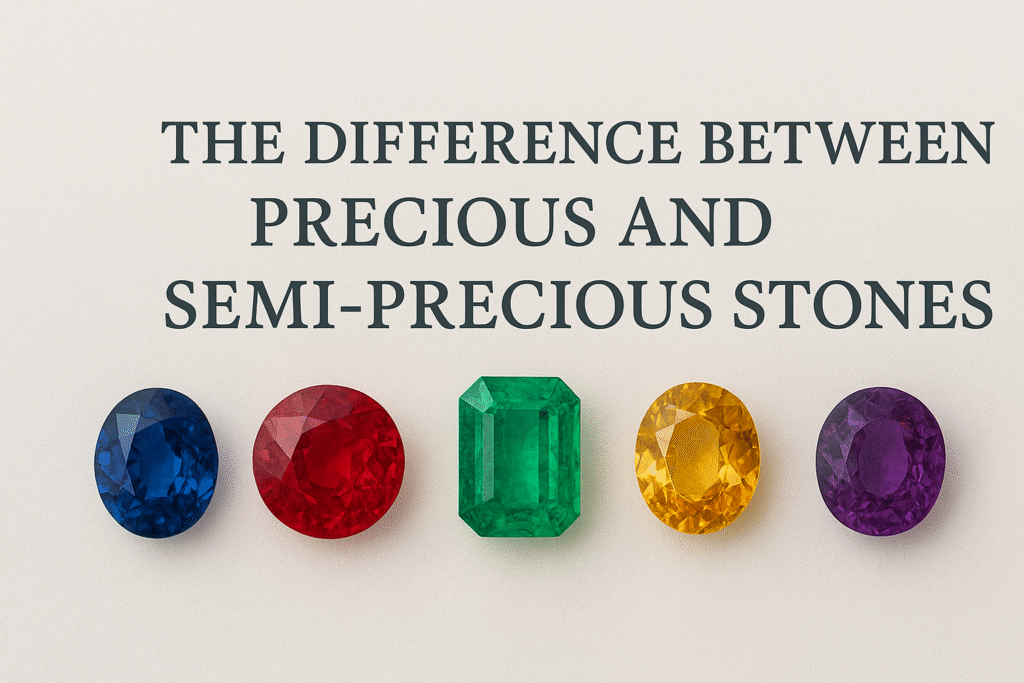
Understanding what separates precious from semi-precious stones requires examining several factors beyond simple categorization. While the traditional classification has historical significance, modern gemology considers a more nuanced approach to evaluating gemstones.
Historical Classification vs Modern Understanding
The precious/semi-precious distinction originated in the mid-1800s when diamonds, rubies, sapphires, and emeralds were genuinely the rarest and most valuable stones available. However, this classification is increasingly viewed as outdated by modern gemologists. The discovery of new gemstone deposits and treatments has dramatically changed the rarity equation, while some semi-precious stones have become more valuable than their precious counterparts.
Rarity and Availability
While precious stones were historically rarer, this is no longer universally true. Fine Burmese rubies and Colombian emeralds remain extremely rare, but diamonds are actually quite abundant due to controlled market supply. Meanwhile, certain semi-precious stones like Paraíba tourmaline, alexandrite, and padparadscha sapphire are far rarer than many precious stones.
Hardness and Durability
Precious stones generally score high on the Mohs hardness scale, with diamonds at 10 and rubies and sapphires at 9. Emeralds are the exception at 7.5-8. Many semi-precious stones like topaz (8) and aquamarine (7.5-8) have comparable hardness, making them equally suitable for everyday jewelry. Softer stones like opal (5.5-6.5) and tanzanite (6-7) require more careful handling.
Value and Price Factors
Price depends on multiple factors beyond classification. A low-quality diamond may cost less than a fine tanzanite. Top-quality Paraíba tourmalines regularly sell for over $20,000 per carat, exceeding many emeralds. The four Cs (color, clarity, cut, and carat weight) apply to all gemstones, along with factors like origin, treatment history, and market demand.
Direct Comparison: Precious vs Semi-Precious
| Factor | Precious Stones | Semi-Precious Stones |
| Number of Types | 4 (Diamond, Ruby, Sapphire, Emerald) | Hundreds of varieties |
| Historical Status | Highest prestige | Lower traditional rank |
| Price Range | Generally higher | Wide range (low to very high) |
| Hardness | 7.5-10 Mohs | 2-8 Mohs (varies widely) |
| Investment Value | Strong track record | Selected stones appreciate |
| Color Options | Limited | Virtually unlimited |
Why Experts Say the Classification Is Outdated
Many gemologists and jewelry experts now consider the precious/semi-precious distinction misleading and potentially harmful to consumers. Here’s why this traditional classification is losing relevance in modern gemology.
Market Values Tell a Different Story
When a fine alexandrite or Paraíba tourmaline sells for more per carat than a diamond, the precious label loses meaning. Fine black opals from Lightning Ridge, Australia, regularly command prices exceeding $10,000 per carat. Rare spinels, long misidentified as rubies in crown jewels, now achieve premium prices. These market realities don’t align with a classification system created in the 1800s.
Scientific Perspective
From a mineralogical standpoint, there’s no scientific basis for the precious/semi-precious division. The Gemological Institute of America (GIA) and other leading gem laboratories don’t use these terms in their grading reports. Instead, they evaluate each stone on its individual merits: color saturation, clarity, cut quality, and carat weight.
Consumer Implications
The outdated classification can lead consumers to undervalue exceptional semi-precious stones or overpay for poor-quality precious stones. A beautiful, well-cut amethyst may provide more enjoyment than a heavily included, poorly cut diamond. Understanding this helps buyers focus on what truly matters: the beauty and quality of the individual stone.
How to Choose the Right Gemstone for You
Whether you’re shopping for an engagement ring, a statement piece, or starting a gemstone collection, here are expert tips for making the best choice.
Consider Your Lifestyle
- For daily wear jewelry like engagement rings, choose harder stones (7+ on Mohs scale) that resist scratching
- Softer stones like opal and pearl work well in earrings and pendants that receive less wear
- Active individuals should consider durability alongside beauty
- Protective settings can help safeguard more delicate stones
Set a Realistic Budget
- Determine your budget before shopping to avoid disappointment
- Consider semi-precious alternatives that offer similar colors at lower prices
- A higher-quality semi-precious stone often provides better value than a lower-quality precious stone
- Factor in setting costs and ongoing maintenance
Prioritize Personal Preference
- Choose colors and styles that genuinely appeal to you, regardless of classification
- Consider birthstones or stones with personal significance
- View stones in person whenever possible to assess their appeal
- Trust your emotional response to a stone – jewelry should bring joy
Ask About Treatments
- Most gemstones undergo some form of treatment (heating, oiling, or irradiation)
- Untreated stones are rarer and typically more valuable
- Some treatments are permanent while others require special care
- Reputable sellers disclose all known treatments
Request Certification
- For significant purchases, obtain certification from recognized laboratories (GIA, AGL, Gübelin)
- Certificates verify authenticity, quality grades, and treatment history
- Origin reports can add significant value for certain stones
- Certification protects your investment and aids future resale
Gemstones as Investments: What You Need to Know
While gemstones can appreciate in value, they should primarily be purchased for enjoyment rather than financial return. However, understanding investment potential can inform buying decisions.
Stones with Strong Investment Potential
- Top-quality Burmese rubies and Colombian emeralds have shown consistent appreciation
- Large, high-quality colored diamonds are increasingly valuable
- Rare semi-precious stones like Paraíba tourmaline have appreciated dramatically
- Untreated stones with certification typically hold value better
Investment Considerations
- Gemstones are illiquid assets that can be difficult to sell quickly
- Market values fluctuate based on trends, discoveries, and economic conditions
- Quality matters more than classification for value retention
- Storage, insurance, and certification add to ownership costs
Conclusion: Beyond Precious and Semi-Precious Labels
The distinction between precious and semi-precious stones, while historically significant, is increasingly viewed as an outdated classification system that doesn’t reflect modern gemological understanding or market realities. The four precious stones – diamond, ruby, sapphire, and emerald – earned their status through centuries of cultural significance, rarity, and beauty. However, many semi-precious stones now rival or exceed them in rarity, beauty, and value.
When choosing a gemstone, focus on what truly matters: the quality of the individual stone, its beauty to your eyes, its suitability for your intended use, and your personal budget. A magnificent tanzanite or opal can be just as precious to its owner as any diamond. The best gemstone is the one that brings you joy, regardless of its traditional classification.
Whether you’re drawn to the timeless elegance of diamonds, the fiery passion of rubies, the serene beauty of aquamarine, or the unique play of color in opals, let your heart guide your choice. In the end, every gemstone has its own story to tell and its own beauty to share.
Ready to explore the world of gemstones? Visit a reputable jeweler, ask questions, and let yourself be captivated by these remarkable treasures of the Earth.
Frequently Asked Questions (FAQs)
Can a semi-precious stone be more valuable than a precious stone?
Yes, absolutely. Several semi-precious stones regularly exceed precious stone prices. Fine Paraíba tourmalines can sell for over $20,000 per carat, high-quality alexandrites command premium prices due to their extreme rarity, and exceptional black opals from Australia can exceed $10,000 per carat. Value depends on individual stone quality, rarity, and market demand rather than traditional classification.
Why isn’t pearl considered a precious stone?
Pearls are organic gems produced by mollusks rather than minerals formed in the Earth. The precious/semi-precious classification traditionally applied only to mineral gemstones. Additionally, pearls were historically more common than the four precious stones. However, natural pearls are now extremely rare and can be incredibly valuable, sometimes exceeding the prices of precious stones.
How can I tell if my gemstone is natural or synthetic?
Natural and synthetic stones can be visually identical since synthetics have the same chemical composition. Professional gemological testing is required for definitive identification. Look for reputable certification from laboratories like GIA, AGS, or Gübelin. Natural stones typically show microscopic inclusions and growth patterns that differ from synthetics. Always purchase from trusted sellers who provide documentation.
Do gemstone treatments affect the value of my stone?
Treatment significantly impacts value and disclosure. Untreated stones are rarer and typically command higher prices, sometimes 50% more or significantly higher for exceptional specimens. Heat treatment in sapphires and rubies is widely accepted and stable. Emerald oiling is standard practice. However, treatments like glass filling or heavy irradiation may reduce value substantially. Always ask about treatments and obtain documentation.
Which semi-precious stones are best for everyday engagement rings?
For daily wear, choose stones with hardness of 7 or above on the Mohs scale. Excellent options include sapphire (all colors, hardness 9), which is second only to diamond in durability. Topaz (8) and aquamarine (7.5-8) are also suitable choices. Moissanite, while not traditional, offers exceptional hardness (9.25) and brilliance at a lower price point. Avoid softer stones like opal, tanzanite, or pearl for engagement rings.
Are lab-created precious stones worth buying?
Lab-created (synthetic) stones offer excellent value for those prioritizing beauty over natural origin. They possess identical chemical, physical, and optical properties to natural stones but cost significantly less. Lab diamonds, rubies, and sapphires are increasingly popular for engagement rings and jewelry. However, they have minimal resale value compared to natural stones. Choose based on your priorities: natural stones for tradition and investment potential, lab-created for maximum beauty per dollar