
Every brilliant diamond, vibrant ruby, or mesmerizing sapphire begins its journey as an unremarkable rough stone. The transformation from raw mineral to dazzling gemstone is nothing short of magical—and it all comes down to the ancient and evolving art of gemstone cutting.
But here’s the challenge: cutting a gemstone isn’t simply about removing material. One wrong angle, one miscalculated facet, and a potentially priceless stone becomes worthless. Master lapidaries spend decades perfecting their craft, combining scientific precision with artistic vision to unlock each stone’s maximum beauty and brilliance.
In this comprehensive guide, you’ll discover everything about the art of gemstone cutting—from the fundamental techniques and essential tools to advanced faceting methods and expert insights that separate amateur cutters from true masters. Whether you’re a jewelry enthusiast, aspiring lapidary, or simply curious about what makes gemstones sparkle, this article will illuminate the fascinating world of precision gem cutting.
What is Gemstone Cutting? Understanding the Fundamentals
Gemstone cutting, also known as lapidary, is the art and science of transforming rough mineral crystals into polished, faceted gems. This ancient craft involves carefully removing material from a raw stone to reveal its optimal color, clarity, and light performance.
The process requires an intimate understanding of a stone’s crystalline structure, optical properties, and physical characteristics. A skilled gem cutter must evaluate each rough stone individually, determining the best cutting approach to maximize both beauty and carat weight retention.
The Science Behind the Sparkle
When light enters a gemstone, it interacts with the faceted surfaces in complex ways. The angles of each facet determine how light refracts, reflects, and disperses within the stone. This interplay creates the fire, brilliance, and scintillation that make cut gemstones so captivating.
Brilliance refers to the white light reflected from the stone’s surface and interior. Fire describes the spectral colors that flash as light disperses through the gem. Scintillation is the sparkle pattern created as light or the viewer moves. Master gem cutters manipulate all three elements through precise facet placement.
Lapidary vs. Faceting: Key Differences
While often used interchangeably, these terms have distinct meanings. Lapidary encompasses all aspects of working with stones, including cutting, shaping, and polishing. Faceting specifically refers to creating flat, polished surfaces (facets) on transparent or translucent gemstones.
A lapidary might create cabochons (smooth, domed stones), carvings, or beads, while a faceter exclusively works on creating geometric patterns of facets that maximize a stone’s optical properties.
The Rich History of Gemstone Cutting Through the Ages
The history of gemstone cutting stretches back thousands of years, with each era contributing new techniques and innovations that built upon previous knowledge.
Ancient Origins and Early Techniques
Archaeological evidence suggests that gemstone polishing began around 3000 BCE in the Indus Valley civilization. Early lapidaries used sand, water, and leather to smooth and polish stones, creating simple cabochon shapes that enhanced color without creating facets.
Ancient Egyptians became skilled at carving softer stones like turquoise and lapis lazuli, while Romans developed techniques for cutting and polishing harder gems. The table cut—a simple flat-topped modification of the natural octahedral diamond crystal—emerged during the late medieval period.
The Renaissance Revolution
The 15th and 16th centuries marked a turning point in gem cutting history. European cutters began experimenting with new shapes and additional facets, leading to the rose cut—featuring a flat bottom and domed top covered with triangular facets.
Venetian and Flemish craftsmen pioneered new cutting wheels and polishing techniques, while gem-cutting guilds in cities like Amsterdam and Antwerp established standards that elevated the craft to new heights.
Modern Innovations and Technology
The brilliant cut, developed in the early 20th century by Marcel Tolkowsky, revolutionized diamond cutting by mathematically calculating the ideal proportions for maximum light return. Today, computer-aided design (CAD), laser cutting technology, and advanced optical analysis continue pushing the boundaries of what’s possible in gem cutting.
Types of Gemstone Cuts: A Complete Overview
Understanding the various cutting styles helps appreciate the artistry and technical skill involved in gem cutting. Each style serves different purposes and showcases different optical qualities.
Brilliant Cuts: Maximizing Fire and Sparkle
The round brilliant cut remains the most popular and scientifically optimized cutting style for diamonds. With 57 or 58 precisely angled facets, this cut maximizes brilliance and fire through calculated light reflection and refraction.
Brilliant cut variations include:
- Round Brilliant: The classic 57-58 facet design, mathematically optimized for maximum light performance
- Oval Brilliant: Elongated shape that appears larger than round cuts of equal carat weight
- Pear Brilliant: Combines pointed and rounded ends for a distinctive teardrop shape
- Marquise Brilliant: Elongated shape with pointed ends that maximizes carat weight appearance
- Heart Brilliant: Romantic shape requiring exceptional skill to achieve proper symmetry
Step Cuts: Elegant and Sophisticated
Step cuts feature rectangular facets arranged in parallel rows, like steps ascending a staircase. These cuts emphasize clarity and color over brilliance, creating a hall-of-mirrors effect with dramatic light and dark reflections.
Popular step cuts include:
- Emerald Cut: Rectangular with cropped corners, traditionally used for emeralds but beautiful in all gems
- Asscher Cut: Square step cut with dramatic light patterns and Art Deco appeal
- Baguette Cut: Elongated rectangular shape often used as accent stones
Mixed Cuts: The Best of Both Worlds
Mixed cuts combine brilliant and step cut techniques, typically featuring a brilliant-cut crown and step-cut pavilion (or vice versa). This approach balances brilliance with weight retention.
Notable mixed cuts:
- Princess Cut: Square or rectangular shape combining brilliant faceting with modern appeal
- Cushion Cut: Rounded square with pillow-like appearance, offering vintage charm
- Radiant Cut: Rectangular with cropped corners and brilliant faceting throughout
Cabochon Cuts: Smooth and Lustrous
Cabochons feature a smooth, domed top with a flat or slightly domed bottom. This style is ideal for opaque stones, those with inclusions creating optical phenomena (like star sapphires or cat’s eye chrysoberyl), or gems with particularly beautiful colors that don’t require faceting to showcase.
Gemstone Cut Comparison Table
The following table compares the key characteristics of different gemstone cutting styles:
| Cut Style | Best For | Key Characteristic | Skill Level |
| Round Brilliant | Diamonds, colorless gems | Maximum brilliance | Advanced |
| Emerald Cut | Emeralds, high-clarity stones | Elegant simplicity | Intermediate |
| Princess Cut | Diamonds, modern styles | Contemporary sparkle | Advanced |
| Cushion Cut | Colored gems, vintage look | Romantic softness | Intermediate |
| Cabochon | Opaque stones, star/cat’s eye | Smooth luster | Beginner |
Essential Tools and Equipment for Gemstone Cutting
Professional gemstone cutting requires specialized equipment designed for precision work. Understanding these tools is essential for anyone interested in lapidary arts.
The Faceting Machine: The Heart of Gem Cutting
A faceting machine is the centerpiece of any gem cutter’s workshop. This precision instrument allows the lapidary to cut exact angles and create perfectly flat facets. Key components include the lap (rotating disk), mast assembly, handpiece, and index gear that controls facet placement.
Leading faceting machine features to consider:
- Precision angle adjustment: Ability to set angles in 0.1-degree or smaller increments
- Index gear system: Multiple index options (96, 80, 72) for varied facet patterns
- Stable mast assembly: Ensures consistent pressure and positioning
- Variable speed motor: Different materials require different rotation speeds
Laps and Polishing Surfaces
Laps are flat disks used for cutting and polishing. Different materials serve different purposes in the gem cutting process.
Common lap types include:
- Diamond laps: Coated with industrial diamond for rough cutting
- Ceramic laps: Used with diamond paste for pre-polishing
- Copper laps: Work well with diamond compounds for fine cutting
- Tin/Lead alloy laps: Traditional choice for final polishing
- BATT laps: Composite laps offering versatility for multiple gem types
Dops and Transfer Fixtures
Dops are the holders that secure rough stones during cutting. The stone is attached to the dop using special wax or epoxy, then the dop fits into the faceting machine’s handpiece. Transfer fixtures allow precise repositioning of the stone to cut the opposite side while maintaining perfect alignment.
Additional Essential Tools
- Loupe (10x magnification): Essential for examining stone quality and cutting progress
- Digital calipers: For precise measurements of rough and finished stones
- Tweezers: Various sizes for handling small stones
- Gem scale: Accurate to at least 0.01 carats
- Light source: Proper lighting is crucial for evaluating cuts
The Gemstone Cutting Process: A Step-by-Step Guide
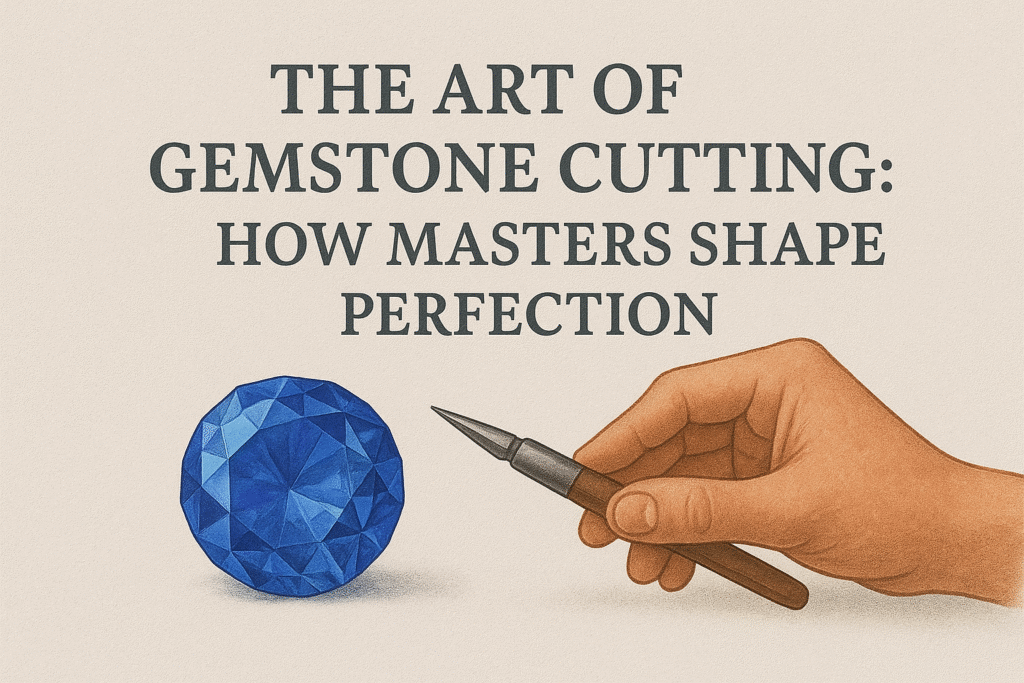
Understanding the complete gemstone cutting process reveals the complexity and skill required to transform rough stones into brilliant gems.
Step 1: Rough Stone Evaluation and Planning
Before any cutting begins, the lapidary must thoroughly examine the rough stone. This evaluation includes assessing color distribution, identifying inclusions, determining crystal orientation, and understanding cleavage planes. The cutter then decides on the optimal shape and cutting style that will yield the most beautiful and valuable finished gem.
Planning also involves calculating the critical angle—the minimum angle at which light will totally internally reflect rather than leak out the bottom of the stone. This varies by gem species; diamonds have a critical angle around 24°, while quartz is approximately 40°.
Step 2: Preforming and Shaping
The preforming stage removes excess material and establishes the basic outline of the finished stone. Using coarse grinding wheels or trim saws, the cutter shapes the rough into an approximate form, reducing waste before the detailed faceting begins.
Careful attention during preforming can make or break a stone’s final appearance. The cutter must consider weight retention while ensuring the preform allows for proper pavilion depth and crown height.
Step 3: Dopping the Stone
The preformed stone is attached to a dop stick using specialized wax or epoxy. Proper dopping is crucial—the stone must be centered and aligned correctly, as any misalignment will carry through the entire cutting process. Temperature control during wax dopping is essential; too hot and the stone could be damaged, too cool and the wax won’t bond properly.
Step 4: Cutting the Pavilion
Most cutters begin with the pavilion (bottom portion of the stone). Using progressively finer laps, the cutter creates each facet at precise angles according to the cutting diagram. The pavilion main facets are typically cut first, followed by break facets and girdle facets.
Each facet must meet others at exact points. “Meetpoints” where multiple facets converge require exceptional precision—any error becomes magnified and visible in the finished stone.
Step 5: Transferring and Cutting the Crown
Once the pavilion is complete, the stone is transferred to cut the crown (top portion). Using a transfer fixture ensures the crown will be perfectly centered on the pavilion. The crown includes the table (flat top facet), star facets, bezel facets, and upper girdle facets.
Crown angles are typically shallower than pavilion angles. The precise ratio between crown and pavilion angles significantly affects the stone’s brilliance and fire.
Step 6: Polishing to Perfection
The final polishing stage transforms cut facets from frosted surfaces to mirror-like faces. This typically involves multiple polishing laps with progressively finer compounds. The goal is achieving a flawless polish that allows maximum light transmission.
Polishing requires patience and attention to detail. Each facet must be individually polished, and the cutter must avoid over-polishing, which can round facet edges and diminish the stone’s optical performance.
Step 7: Final Inspection and Quality Control
The finished stone undergoes thorough inspection. The cutter examines symmetry, polish quality, facet alignment, and overall light performance. Professional gemologists use specialized equipment like proportion analyzers and light performance imaging systems to evaluate cut quality objectively.
Common Challenges in Gemstone Cutting and How to Overcome Them
Even experienced gem cutters face challenges that can compromise their work. Understanding these obstacles helps lapidaries avoid costly mistakes.
Dealing with Inclusions
Natural inclusions present constant challenges. The cutter must decide whether to cut around inclusions (sacrificing size), position them strategically where they’re less visible, or cut through them if they’re minor. Some inclusions, like rutile needles in star sapphires, are actually desirable and require specific orientation to display properly.
Cleavage and Fracture Risks
Many gemstones have cleavage planes—directions where the crystal structure is weaker and more likely to split. Diamonds have perfect octahedral cleavage, topaz cleaves easily in one direction, and fluorite has perfect cleavage in four directions. Cutters must orient stones carefully and avoid applying excessive pressure along cleavage planes.
Heat Sensitivity
Friction during cutting generates heat, which can damage heat-sensitive stones. Opals, tanzanite, and certain treated gems require extra caution. Using adequate water lubrication, reducing cutting speed, and allowing cooling periods helps protect vulnerable stones.
Achieving Perfect Symmetry
Symmetry errors become increasingly noticeable as the cut progresses. A slight misalignment early in the process compounds with each subsequent facet. Master cutters develop techniques to check alignment frequently and make micro-adjustments to maintain precision throughout the cutting process.
Expert Tips from Master Lapidaries
Wisdom gained through decades of gem cutting experience provides invaluable guidance for developing lapidaries.
Start Simple and Build Skills Gradually
Beginning cutters should start with inexpensive synthetic materials like cubic zirconia or lab-created corundum. These materials are forgiving and allow practice without the pressure of potentially ruining valuable rough. Progress to natural stones only after developing consistent technique.
Invest in Quality Equipment
While expensive, high-quality faceting machines and laps provide the precision necessary for excellent results. A cheaper machine with calibration issues will frustrate the cutter and produce inferior results regardless of skill level. Consider used equipment from reputable sources as a cost-effective alternative.
Master the Fundamentals Before Attempting Advanced Cuts
Standard round brilliant and simple rectangular cuts teach essential skills that apply to all faceting. Understanding light behavior, achieving proper meetpoints, and developing consistent technique comes through repetition of fundamental cuts. Only after mastering basics should cutters attempt complex designs.
Patience is Your Greatest Asset
Rushing any stage of gem cutting typically leads to errors that become impossible to correct later. Master lapidaries emphasize taking time at every step—careful evaluation, methodical cutting, and thorough polishing. A stone that took weeks to cut well will bring satisfaction for a lifetime.
Pursuing a Career in Gemstone Cutting
For those passionate about combining artistry with technical precision, gemstone cutting offers rewarding career opportunities.
Educational Pathways
Formal gemology programs from institutions like the Gemological Institute of America (GIA) provide comprehensive education in gem identification, grading, and cutting. Many successful cutters also learn through apprenticeships with established masters, community college programs, or intensive workshop courses.
Career Opportunities
Professional gem cutters find employment in various settings:
- Jewelry manufacturers: Cutting gems for production jewelry lines
- Custom jewelers: Creating bespoke cuts for individual clients
- Gem dealers: Maximizing value of rough stone inventory
- Independent artisan: Selling directly to collectors and jewelry designers
- Education and training: Teaching the next generation of lapidaries
The Future of Gemstone Cutting: Technology Meets Tradition
The gem cutting industry continues evolving as new technologies emerge while honoring centuries-old traditions.
Computer-Aided Design and Analysis
Modern gem cutters increasingly use software to analyze rough stones and plan optimal cuts. Three-dimensional scanning creates precise models of rough material, allowing cutters to visualize different cutting approaches and predict light performance before any material is removed.
Laser Technology
Laser systems now assist with marking, sawing, and even creating certain cut patterns. While lasers haven’t replaced traditional faceting machines for most work, they offer precision for specific applications like creating perfectly straight bruting lines or removing difficult inclusions.
Automated Cutting Systems
For commercial production, automated cutting systems can produce consistent calibrated stones at high volumes. However, the finest cuts still require human expertise. Computer-controlled systems lack the ability to make creative decisions about color optimization and dealing with unexpected inclusions that distinguish master cutters.
Conclusion: The Timeless Craft of Creating Beauty from Stone
The art of gemstone cutting represents a remarkable intersection of science, artistry, and patience. From ancient lapidaries polishing rough stones by hand to modern masters wielding precision faceting machines, the goal remains unchanged: revealing the hidden beauty within each unique gem.
Whether you’re drawn to gem cutting as a potential career, a fulfilling hobby, or simply appreciate the craftsmanship behind beautiful jewelry, understanding this art form deepens appreciation for every sparkling stone you encounter.
The journey from rough crystal to brilliant gem is one of transformation—not just of the stone, but of the cutter who learns to see potential where others see only rock. Every master lapidary began as a beginner, and the path to excellence is open to anyone willing to invest the time, patience, and dedication this remarkable craft demands.
Ready to explore the world of gemstone cutting? Consider visiting a local gem and mineral show, taking an introductory lapidary class, or connecting with gem cutting communities online. The brilliant world of precision faceting awaits your discovery.
Frequently Asked Questions About Gemstone Cutting
How much does it cost to start gemstone cutting as a hobby?
Entry-level faceting equipment typically ranges from $1,500 to $3,500 for a basic setup including a faceting machine, essential laps, and necessary accessories. More advanced professional-grade equipment can cost $5,000 to $15,000 or more. Many beginners reduce initial costs by purchasing quality used equipment or starting with cabochon cutting, which requires less expensive tools.
How long does it take to cut a single gemstone?
Cutting time varies significantly based on stone size, hardness, complexity of the design, and the cutter’s experience level. A simple cabochon might take 1-2 hours, while a standard round brilliant could require 4-8 hours. Complex competition-level cuts with dozens of precisely placed facets can take 20-40 hours or more to complete properly.
What percentage of a rough stone is typically lost during cutting?
On average, 40-60% of the rough material is removed during the cutting process. For diamonds, this figure can reach 50-70% because achieving ideal optical proportions takes priority over weight retention. Highly included or irregularly shaped rough may have even higher material loss as cutters work around flaws to maximize clarity.
Can damaged or scratched gemstones be recut?
Yes, most gemstones can be recut to remove surface damage, chips, or scratches. However, recutting inevitably reduces carat weight, which may significantly affect value. The decision to recut depends on the severity of damage, the stone’s original value, and whether the damage is superficial or extends deeper into the gem.
Why do the same type of gemstones sparkle differently?
Light performance in gemstones depends heavily on cut quality, not just the material itself. Two diamonds of identical size and clarity can appear dramatically different if one is ideally cut and the other has poor proportions. Facet angles, symmetry, polish quality, and the relationship between crown and pavilion all influence how light interacts with the stone.
Is it possible to learn gemstone cutting online?
While online resources, video tutorials, and virtual courses can teach theory and basic techniques, gemstone cutting truly requires hands-on practice with proper equipment. Online learning provides an excellent foundation and can guide skill development, but cannot replace the tactile experience of working with actual stones. Many successful cutters combine online education with local workshops, mentorship, or lapidary club memberships for practical experience.